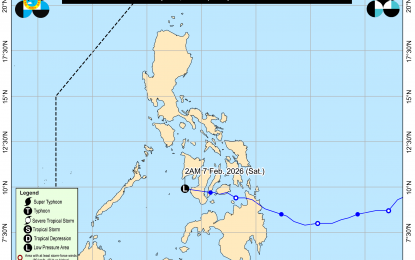
Tropical Storm Basyang (international name Penha) has weakened into a low-pressure area (LPA) after encountering unfavorable environmental conditions, the state weather bureau announced early Saturday morning.
In its 5:00 a.m. bulletin, the Philippine Atmospheric, Geophysical and Astronomical Services Administration (PAGASA) reported that the storm downgraded at approximately 2:00 a.m. on February 7.
The LPA was last spotted 105 kilometers southeast of Cuyo, Palawan.
Despite the weakening, PAGASA warned that the remnant low and the prevailing shear line will continue to trigger significant rainfall across the archipelago.
Forecasters expect 50 mm to 100 mm of rain over Palawan, Oriental Mindoro, Negros Occidental, Antique, Iloilo, and Guimaras due to the LPA, while the shear line is projected to bring heavy rains to Quezon and Camarines Norte.
Weather officials cautioned that mountainous and elevated areas are at a higher risk of flooding and landslides, particularly in regions that have already experienced significant rainfall over the past several days.
The surge of the northeast monsoon continues to bring strong to gale-force gusts to most of Luzon, Western Visayas, Zamboanga del Norte, and the Negros Island Region.
Hazardous sea conditions remain a primary concern, with rough seas of up to four meters expected near the Babuyan Islands and Ilocos Norte.
Waves of up to three meters may affect the seaboards of Ilocos Sur, Cagayan, Isabela, Aurora, northern Quezon, and the Polillo Islands.
Small seacraft and motor bancas are advised to remain in port, while larger vessels are urged to exercise caution due to the turbulent conditions.
The LPA is expected to move west-northwestward across northern Palawan before potentially dissipating over the Sulu Sea.
Cloudy skies with scattered rains and thunderstorms are forecast for Mimaropa and Western Visayas.
Metro Manila, Calabarzon, and the Bicol Region can expect similar conditions due to the shear line, while the northeast monsoon will bring light rains to the rest of Northern Luzon.