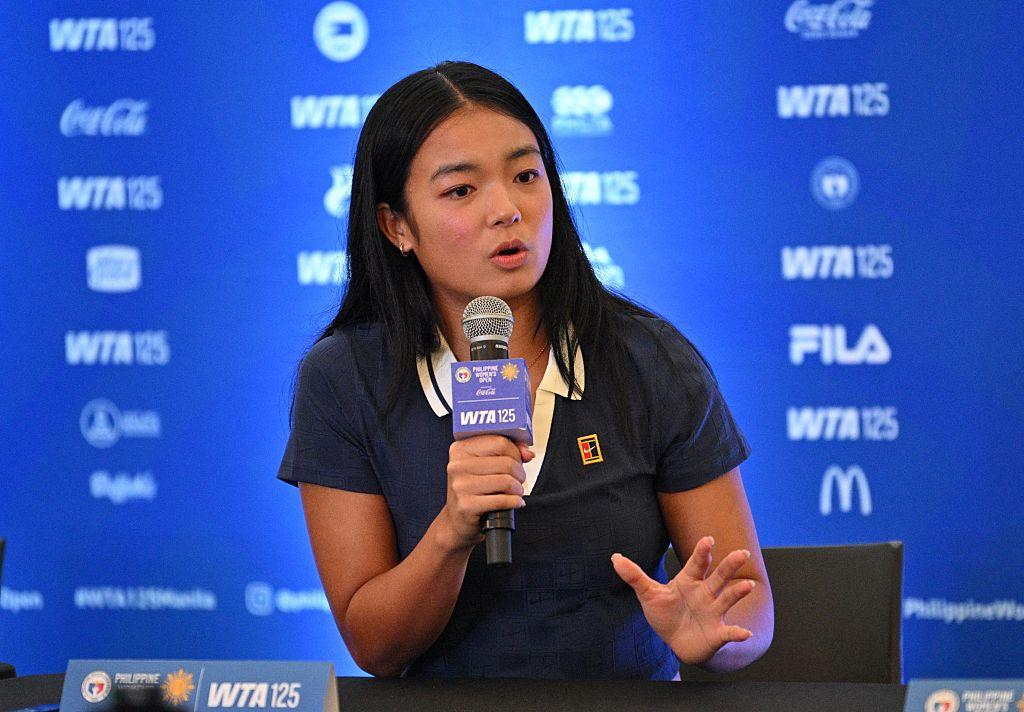

There was a time when Alexandra Eala could walk into a tournament venue as a promising junior, quietly sharpening her game between practice courts and match arenas. Today, that anonymity is gone.
At just 20 years old, Eala is not only the face of Philippine tennis — she is, by any measure, one of the most watched and talked-about players in the sport right now. In an era driven by viral clips, 24-hour sports coverage, and relentless social media engagement, she has become a global attraction. Every practice session draws cameras.
Every appearance triggers a wave of smartphones. Every reaction — win or lose — is dissected in real time.
With that super popularity comes a new opponent: pressure.
In a recent interview, Eala addressed the growing scrutiny surrounding professional players, particularly in light of the controversy involving Coco Gauff at the Australian Open. Gauff’s private moment — smashing her racquet after a tough loss — was caught on camera, sparking debate about whether players are ever truly off the record.
For Eala, the incident underscored a deeper issue.
“I do value privacy a lot,” she said. “I think everyone has the right to their own privacy and sometimes being a public figure, the lines are a little bit blurred. I think everybody should have the right to draw the line of privacy.”

Her words carried particular weight given her current standing in the sport. Eala is no longer simply a rising talent — she is a headline act. Tournament organizers understand her draw. Broadcasters know her matches spike viewership. In Doha, during her debut at the Qatar Open, she was placed on Center Court despite not being seeded — a clear signal of her market pull.
The result did not go her way. She fell in the opening round to teenage Czech Tereza Valentova, missing a valuable opportunity to gain ranking points. But the story extended beyond the scoreboard. The atmosphere surrounding her matches now resembles that of a veteran Grand Slam contender.
The expectations are immense — from fans in Manila staying up past midnight, from sponsors investing in her brand, and from global audiences tuning in to watch the Filipina trailblazer.
Eala has already rewritten Philippine tennis history. She became the first Filipino to crack the top 100, then the top 50, eventually reaching a career-high ranking inside the top 40. She has defeated former Grand Slam champions, stunned top-10 opponents, and reached the semifinals of a WTA 1000 event — milestones that once seemed distant dreams for Southeast Asian tennis.
But popularity amplifies everything. Victories are celebrated louder. Defeats sting harder. And private moments grow scarce.
She admits that adjusting to constant visibility is still a work in progress. “When people see me, the phone is the first thing they reach out for,” she noted. “Which is something that I have to adjust to.”
For a player barely out of her teens, navigating that balance between access and autonomy is as demanding as any three-set battle. The professional circuit already demands technical refinement, physical resilience, and mental toughness. Add to that the burden of being the most recognizable Filipino athlete on tour — arguably the most talked-about young player globally at this moment — and the psychological load intensifies.
Next comes another major test at the Dubai Duty Free Tennis Championships. Like Doha, it is a WTA 1000 stage. Like Doha, she is expected to draw marquee placement and packed stands. And like every tournament now, it will unfold under a microscope.
Yet those close to Eala insist that the spotlight, while blinding at times, is not something she resents. It is a byproduct of impact. The Philippines has not had a tennis figure of this magnitude before. She carries not just a racquet, but the aspirations of a nation eager for global sporting relevance.
The tension lies in protecting the person behind the persona.
Professional athletes are increasingly grappling with a paradox: visibility fuels opportunity, but exposure erodes privacy. Locker rooms are no longer guaranteed sanctuaries. Practice courts are content streams. Emotional reactions risk becoming viral footage.
Eala’s message was not a rejection of fame. It was a call for boundaries.
As she continues her climb, the challenge will be twofold — mastering opponents across the net and mastering the noise beyond it. If her career so far is any indication, she is capable of both. But in a sport that measures margins in millimeters, safeguarding mental space may prove just as critical as landing a first serve on the line.
Under the brightest lights tennis has to offer, Alex Eala is learning that greatness today requires more than power and precision. It requires resilience against pressure, and the courage to insist on something simple — the right to draw her own line.