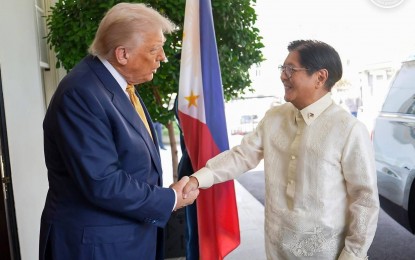
United States President Donald Trump emphasized the strategic significance of the proposed ammunition manufacturing facility in Subic Bay, Zambales, stating that it would enhance both Philippine defense capabilities and US military readiness.
“It’s very important. Otherwise, we wouldn’t have approved it,” Trump remarked early Wednesday (Manila time) during a press conference at the White House following his bilateral meeting with President Ferdinand R. Marcos Jr., who is in the US for a three-day official visit. He added, “We need ammunition. We’re going to end up in a few months, we’ll have more ammunition than any country has ever had… missiles, the speedy ones, the slow ones, the accurate ones — we have everything.”
The proposed joint project, to be established in the Subic Bay Freeport Zone, is part of a broader US-Philippines defense cooperation agenda under the Enhanced Defense Cooperation Agreement (EDCA), particularly in light of rising tensions in the South China Sea and the wider Indo-Pacific region. The US House Committee on Appropriations has directed its Department of Defense, State Department, and the International Development Finance Corporation to assess the feasibility of establishing such a facility in Subic Bay.
Marcos clarified that the ammunition production initiative aligns with the country’s Self-Reliant Defense Posture (SRDP), with US support aimed at bolstering the Philippines’ own defense capabilities. “This is actually (the US) assisting the Philippines in what we call our self-reliance defense program, which is to allow us to be self-reliant and to be able to stand on our own two feet, whatever the circumstances that occur in the future,” Marcos stated.
Regarding the potential hosting of more US missile systems, Marcos noted that any military modernization effort is a response to the evolving security environment. “We would certainly like any kind of military spending — we would wish that it wasn’t necessary, but it is,” he added.
The Subic site, a former US naval base that has transitioned into a commercial hub, is considered strategically important due to its proximity to the West Philippine Sea, a resource-rich area within the Philippines’ exclusive economic zone that overlaps with the vast South China Sea, which is entirely claimed by China.