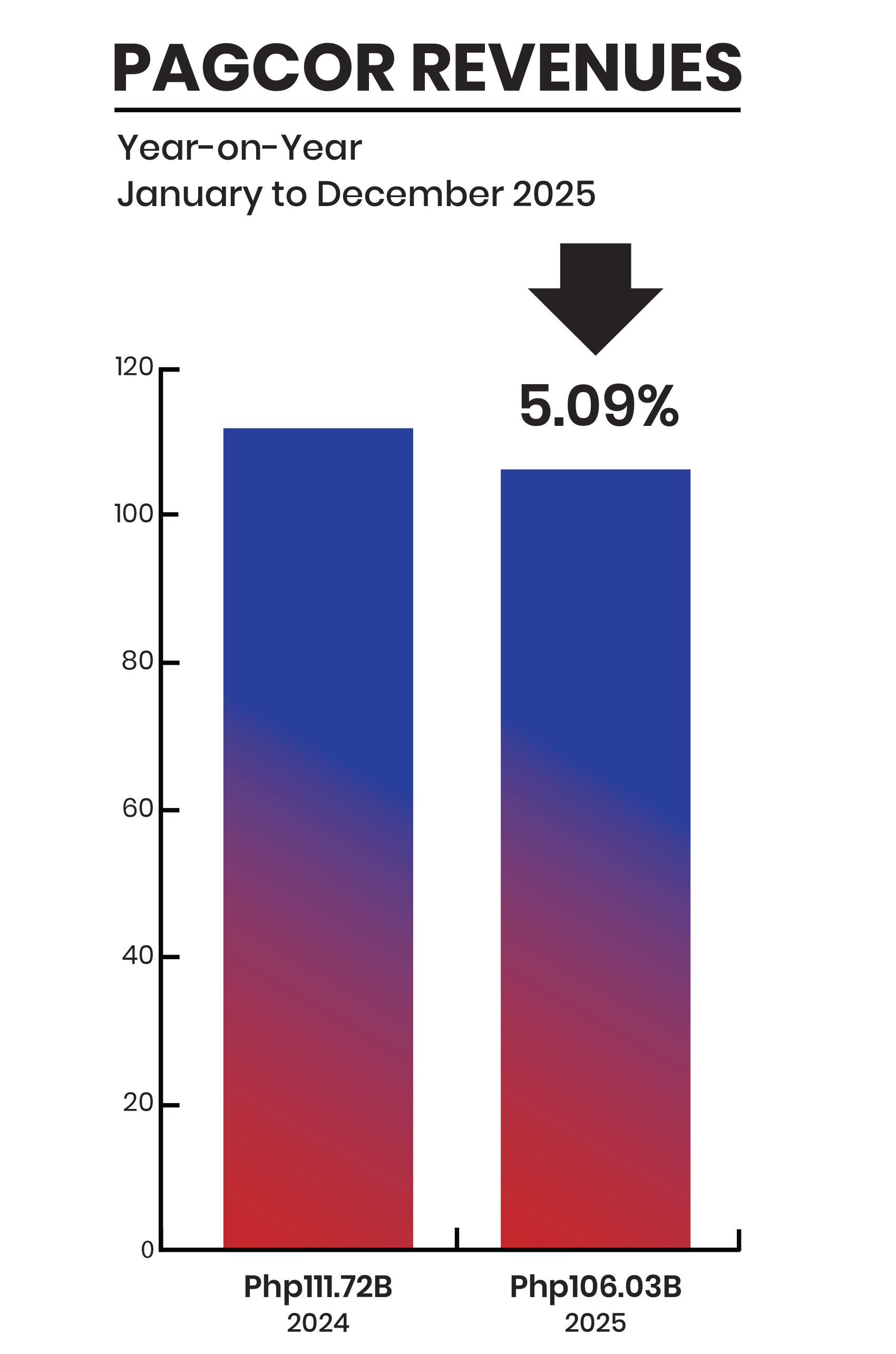

The Philippine Amusement and Gaming Corporation (PAGCOR) closed 2025 with total revenues of P106.03 billion, a 5.09 percent decline from P111.72 billion in 2024, reflecting softer earnings from land-based casinos and the absence of offshore gaming in its revenue mix.
Gaming operations remained the corporation’s main revenue driver, generating P95.15 billion, slightly below the P97.53 billion recorded a year earlier. Non-gaming income streams, including interest earnings, other income, and service fees, contributed an additional P10.88 billion.
A clear bright spot emerged from digital platforms. More than half of PAGCOR’s gaming revenues, or P53.33 billion, came from electronic and online gaming activities such as eGames, eBingo, and bingo grantees. Revenues from these segments rose 9.30 percent year-on-year, helping cushion the drop from traditional casino operations.
PAGCOR Chairman and CEO Alejandro H. Tengco said revenues from PAGCOR-operated casinos fell sharply by 18.12 percent to Php10.38 billion, while licensed casinos generated P31.44 billion, down 4.93 percent from 2024.

The decline, Tengco explained, reflects a broader shift in player preferences. Customers are increasingly gravitating toward digital and online gaming platforms, gradually reshaping the country’s gaming landscape.
This changing behavior, he noted, has pushed regulators to adapt. PAGCOR has strengthened its regulatory framework for online gaming, rolling out upgrades aimed at protecting players, promoting responsible gaming, and ensuring transparency in a rapidly expanding digital environment.
Overall gaming revenues were also weighed down by the offshore gaming ban. The segment contributed nearly P3 billion in 2024 but was no longer part of PAGCOR’s revenue base in 2025, further pulling down year-on-year totals.
Despite the revenue dip, PAGCOR delivered stronger profitability. Net income climbed 4.18 percent to P17.47 billion in 2025, up from P16.77 billion the previous year, highlighting improved efficiency and the stabilizing role of online gaming revenues.
PAGCOR’s contributions to nation-building reached P66.95 billion, only slightly lower than P68.21 billion in 2024. The largest share went to the National Treasury, which received P45.19 billion as the government’s 50 percent share, including the mandatory P60 million contribution to the Dangerous Drugs Board.
Additional allocations included Php4.76 billion in franchise taxes and Php907 million in corporate income taxes remitted to the Bureau of Internal Revenue. The Philippine Sports Commission received Php2.26 billion, while Php95.08 million was set aside as cash incentives for athletes and coaches who brought home honors from international competitions.
PAGCOR also earmarked P12.77 billion for socio-civic programs, including initiatives under the Office of the President. Other mandated beneficiaries included host cities of Casino Filipino branches, which received P678.10 million, the Department of Justice’s Board of Claims with P123.98 million, and the Renewable Energy Trust Fund, which was allocated P169.89 million.
While 2025 highlighted the challenges facing land-based gaming, PAGCOR’s results underscored a clear trend: digital gaming is no longer just a complement to traditional casinos, but a central pillar of the industry’s future.