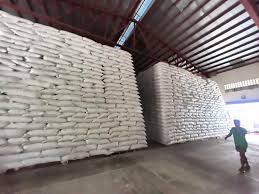

Despite recent typhoons battering several provinces, the country’s rice reserves remain intact and sufficient, according to the National Food Authority (NFA), which assured the public on Saturday that its warehouses nationwide continue to hold ample rice stocks.
NFA Administrator Larry Lacson, speaking in a radio interview, said the agency’s supply chain held strong even after multiple storms, with only two facilities sustaining minimal damage — one in Alaminos, Pangasinan and another in La Union.
“Our rice reserves have not been significantly depleted,” Lacson said. “Even during the storms, we were prepared. Out of all our warehouses, only two sustained minor damage.”
Currently, the NFA has about 452,000 metric tons of palay in storage — equivalent to roughly nine million sacks of milled rice — which can sustain the nation’s needs for 12 days under emergency buffer stock protocols. Lacson attributed the steady supply to increased procurement from local farmers.
“What comes in from our local purchases outweighs what goes out,” he noted, emphasizing that more palay is being bought from farmers than the volume being distributed.
In a bid to strengthen farmer incomes and public access to affordable food, the NFA is now coordinating with the Department of Agriculture (DA) to launch a new initiative: establishing Kadiwa stores directly within NFA warehouse sites.
Initially set for rollout in Regions 1 and 3, the stores — branded under the “Kadiwa ng Pangulo” program — aim to provide farmers with a direct channel to sell their produce while ensuring nearby communities can access affordable food staples.
“These stores will be set up right at the warehouses,” Lacson said. “It’s a win-win — farmers have more selling options, and consumers benefit from lower prices.”
This development comes in the wake of widespread damage caused by Tropical Cyclones Crising, Dante, and Emong, as well as the southwest monsoon. According to official data, the storms affected over 7.6 million individuals, with Central Luzon bearing the brunt at over 2.8 million people impacted.
In total, infrastructure damage from these weather events is estimated at over P10 billion, with nearly P2 billion in losses recorded in the agriculture sector alone.
Despite these setbacks, the NFA emphasized that its core mission — maintaining food security — remains uncompromised, buoyed by resilient systems and a proactive response strategy.
As more Kadiwa outlets are expected to be rolled out nationwide, the agency is optimistic that this integrated approach will not only stabilize food supply but also bring real economic value to Filipino farmers.