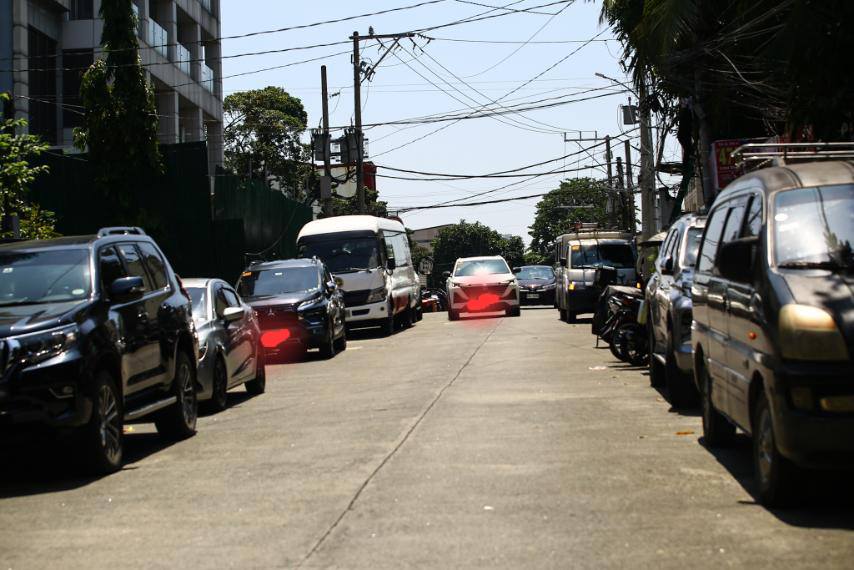

In a growing call to reclaim public roads for people rather than private vehicles, a lawyers’ group is urging a full prohibition on street parking across Metro Manila, stressing that allowing parked cars to occupy public roads is both illegal and outdated.
The Lawyers for Commuters Safety and Protection (LCSP) issued a firm statement on Saturday pushing beyond a proposal currently under review by the Department of the Interior and Local Government (DILG). The DILG’s proposal—endorsed in a recent meeting with the Metro Manila Council—suggests a partial street parking ban during key hours, from 5 a.m. to 10 p.m. The Metropolitan Manila Development Authority (MMDA) wants the restriction narrowed to peak traffic periods.
But for LCSP, these measures barely scratch the surface of the capital’s mobility problems.
“This isn’t just about freeing up space during rush hour. It’s about redefining who our roads are meant to serve,” said the group in a statement. “Illegally parked cars don’t belong on streets, regardless of the time.”
Public space vs. private convenience
According to LCSP, current city ordinances allowing street parking directly contradict Republic Act No. 4136, which already prohibits such use of public roads. Enforcement, they said, has been lax and inconsistent, leading to traffic bottlenecks, safety hazards, and limited mobility options for pedestrians and emergency responders.
“Even at night, these vehicles block critical access routes for ambulances and fire trucks. A parked car may be silent—but it’s a danger all the same,” the group noted.
Their stance underscores a broader mobility issue in Metro Manila, where streets are increasingly congested not by moving traffic, but by parked vehicles turning public thoroughfares into private garages.
A demand for systemic overhaul
The group emphasized that piecemeal measures won’t work without addressing deeper systemic flaws. They’re calling on Congress to revive proposals that require proof of parking space before anyone can register a new vehicle—a measure that’s repeatedly stalled in legislative chambers.
“We need a future-forward transportation policy,” said LCSP. “One that doesn’t just regulate traffic but actively discourages car dependency.”
Push for public transport investment
At the core of LCSP’s message is a call to shift the focus from cars to people. They say meaningful progress will only come when the government invests in efficient, affordable, and safe public transport systems.
“A single bus can move 50 people in the space occupied by one to two cars. The math is simple—if we want to reduce congestion, we need fewer cars and more buses, trains, and bike lanes,” the group emphasized.
They echoed long-standing calls from mobility advocates to transform Metro Manila into a more commuter-friendly city where walking, cycling, and public transportation become the default modes of movement.
Cities cautious, but dialogue continues
Despite the lawyers’ strong push for a sweeping street parking ban, Metro Manila’s city mayors remain cautious. San Juan Mayor and Metro Manila Council chairman Francis Zamora noted that local executives still favor retaining parking on less-congested roads. A technical working group is now tasked with determining which roads may be subjected to the parking prohibition.
The DILG aims to release the final version of the policy by September 1, though it is unclear whether it will adopt a stricter stance or stick to a more limited approach.
The road ahead
For LCSP and other advocates, the debate around street parking is part of a larger battle over urban space. With more than 13 million people navigating Metro Manila daily, they argue that the city can no longer afford to prioritize car storage over human movement.
“Street parking isn’t just a nuisance—it’s a symbol of misplaced priorities,” the group concluded. “It’s time to reclaim our roads for people, not for parked cars.”