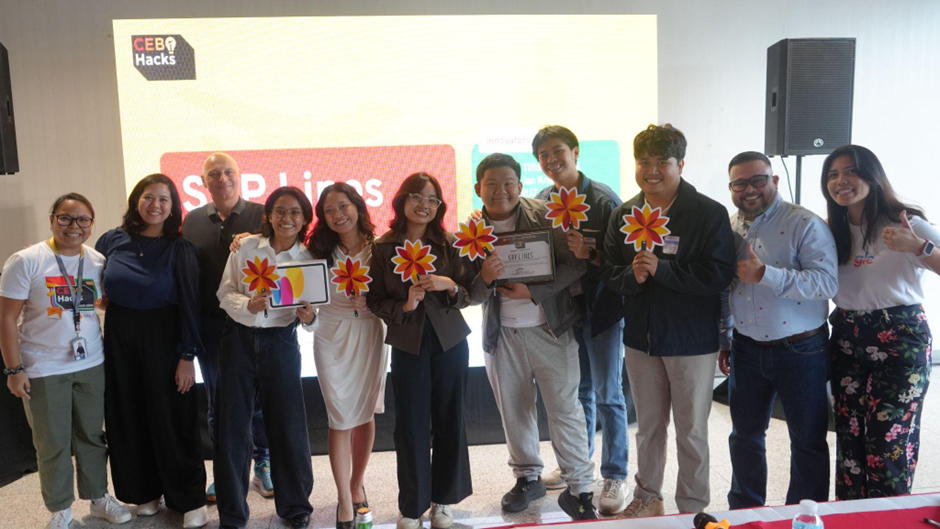

Team SRP Lines of the University of the Philippines Cebu as the first CEB-i Hacks winner.
Cebu, Philippines — Mactan-Cebu International Airport capped off its ambitious CEB-i Hacks innovation challenge with a high-energy Demo Day on January 24, 2025, putting the spotlight on how artificial intelligence can reshape the future of travel and tourism in Cebu.
The event marked the culmination of a rigorous 24-week journey that brought together some of the province’s brightest student innovators, all driven by a shared goal: to reimagine the airport and tourism experience through technology.
CEB-i Hacks drew strong interest from across the academic community, attracting 87 teams composed of 448 students from 11 schools and universities in Cebu. From this pool, a Top 25 of 113 students representing five universities advanced to an intensive mentorship phase, where ideas were refined, challenged, and aligned with real-world industry needs.
The process eventually narrowed the field to 10 finalist teams who earned the opportunity to pitch their concepts on Demo Day.
Students from leading institutions such as the University of the Philippines Cebu, University of San Jose-Recoletos, and Cebu Institute of Technology-University took center stage, presenting AI-powered solutions before a panel of industry leaders.
Their proposals demonstrated how generative AI tools, including Google Gemini, could be harnessed to improve airport operations, enhance passenger experience, and strengthen Cebu’s appeal as a tourism destination.
At the end of the pitch session, Team SRP Lines emerged as champion for its concept proposal Nofy, followed by Team A.I.Con as first runner-up with CeVIEW, and Team CeSAVY as second runner-up for its project SaBAI. Judges from MCIA, Globe Business, Google Cloud, and Mata Technologies assessed the entries based on innovation, feasibility, and their potential impact on both airport efficiency and the overall tourism ecosystem.
The program reflects MCIA’s broader transformation from a transport hub into a platform for digital innovation. According to Christine Villanueva, head of strategy and communications of Aboitiz InfraCapital Cebu Airport Corporation, CEB-i Hacks is designed to give young innovators a direct runway to co-create solutions that can redefine how people experience travel in Cebu.
She said the initiative underscores MCIA’s commitment to becoming not only a gateway to the province, but a gateway to innovation.
In partnership with Google Cloud and Globe Business, participating students received hands-on training and capacity-building workshops that exposed them to cutting-edge AI technologies. The initiative also benefited from the support of The Sandbox Foundation and the Cebu Chamber of Commerce and Industry, highlighting a rare collaboration among the academe, private sector, and innovation advocates to build a future-ready tourism ecosystem in the Visayas.
As the winning teams move forward with their ideas, MCIA’s message is clear: the future of tourism in Cebu will be shaped not only by destinations and infrastructure, but by the digital intelligence that powers every step of the journey.