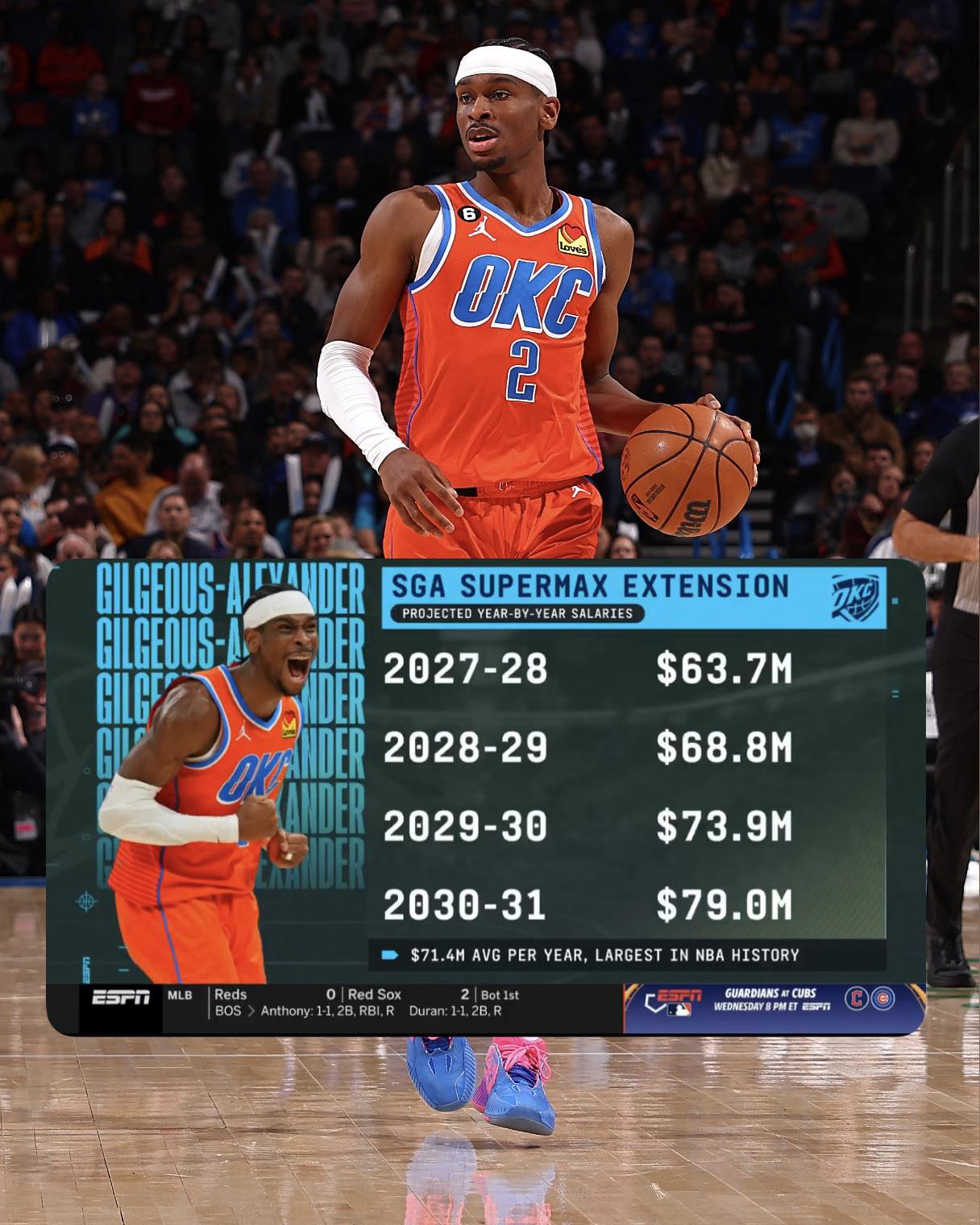

The NBA is hurtling toward a financial frontier: the first $1 million-per-game contract. Oklahoma City’s Shai Gilgeous-Alexander came close with his new four-year supermax extension that will pay him $79 million in its final year. But that historic milestone—$82 million in a single season—may be reached sooner than many expect.
Two main forces are pushing NBA salaries into uncharted territory: rising salary caps and the supermax contract, which allows eligible players to earn up to 35% of the cap. Combine that with the NBA’s new $76 billion broadcast deal kicking in next season, and annual salary cap hikes of 7–10% become the norm, not the exception.
To put it into perspective, the salary cap has more than doubled over the past decade—from $63 million to over $140 million. By 2034, projections suggest it could surpass $300 million. With those increases, supermax deals could easily pay top players upwards of $82 million per year—or over $1 million per game.
Who could be the first?
Gilgeous-Alexander’s deal may not break the $1 million-per-game mark, but several rising stars are positioned to do so. Anthony Edwards is the leading candidate. With two All-NBA Second Team selections already under his belt, he could sign a supermax extension in 2027 worth as much as $345 million over four years—crossing the $82 million threshold by Year 2.
Other young stars like Cade Cunningham, Evan Mobley, Scottie Barnes, and Victor Wembanyama could soon follow. Even current stars like Devin Booker, who just inked a two-year $145 million extension, are pushing per-season payouts into rarified air.
Why it’s still a bargain
It sounds outrageous—$1 million for a single night’s work. But consider this: NBA teams spent over $5.6 billion on salaries and taxes last season. That breaks down to about $4.6 million per regular season win. Gilgeous-Alexander alone was worth nearly 21 wins, or roughly $96 million in value—not including playoffs, merchandise, or franchise valuation boosts.
Historically, elite players like LeBron James and Michael Jordan have generated value far exceeding their salaries. With the cap set to rise exponentially, the league’s top earners will still be underpaid relative to their true worth.
More money, more complications
As salaries grow, so do the ripple effects. There’ll be greater public scrutiny around load management—fans may balk at $1 million sit-outs. Players might prioritize legacy or winning over squeezing every last dollar. And with contracts ballooning, debates about player compensation will intensify.
But make no mistake: the $1 million-per-game milestone isn’t a matter of if. It’s a matter of who gets there first—and just how high the ceiling will rise after that.
In an NBA where the financial sky is no longer the limit, even $100 million seasons are becoming possible. And believe it or not, they might still be a steal.