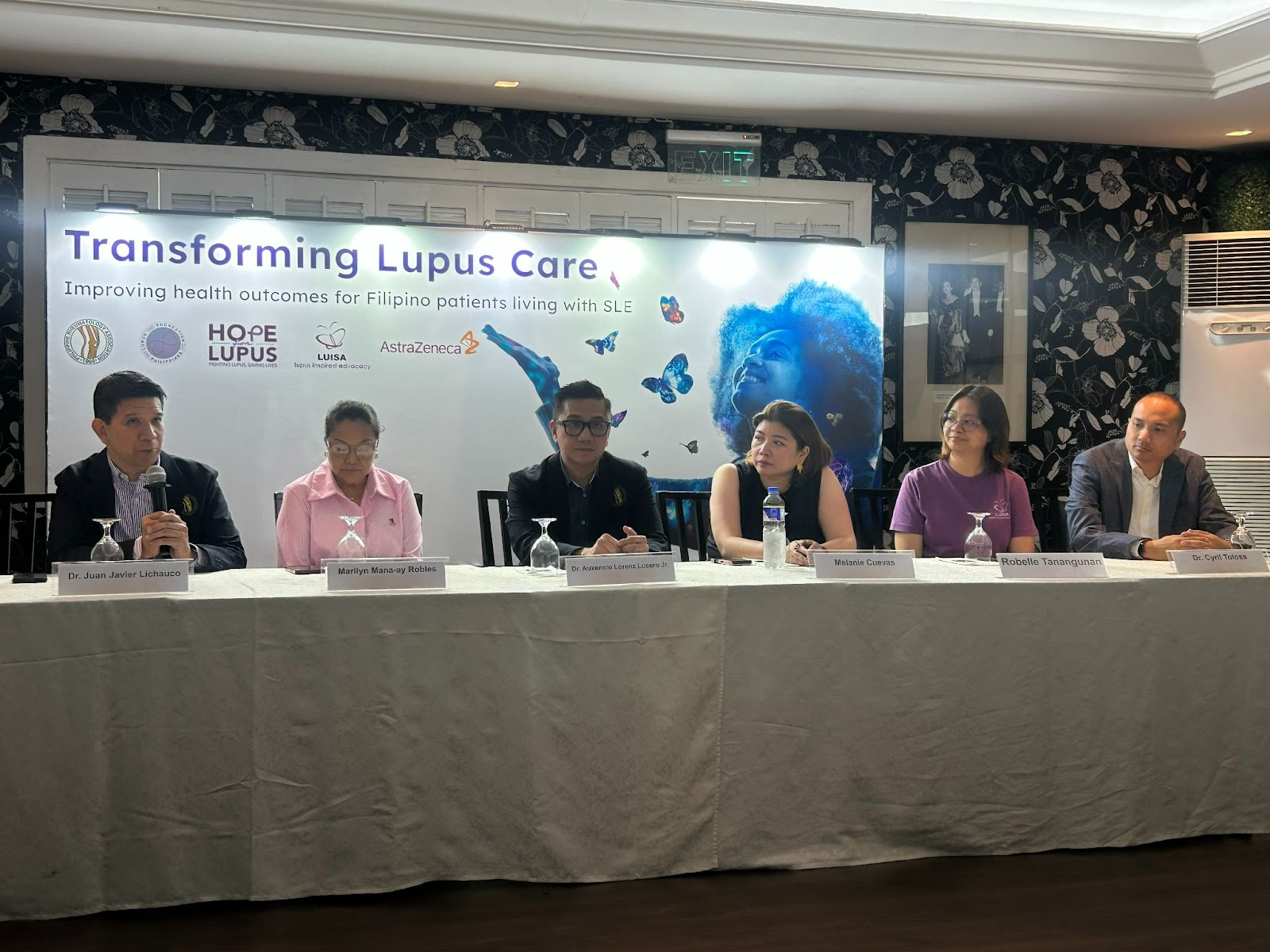

The roundtable on lupus awareness and advocacy, held in Makati and convened by AstraZeneca Philippines, successfully brought together leading rheumatologists, patient advocates, researchers, and medical professionals to address the persistent challenges of lupus care in the country. The group included (from L–R): Dr. Juan Javier Lichauco, keynote lecturer and rheumatology expert; Mrs. Marilyn Mana-ay Robles, president of the Lupus Foundation of the Philippines; Dr. Auxencio “Chito” Lorenz Lucero Jr., current president of the Philippine Rheumatology Association; Ms. Melanie Cuevas, board member of Hope for Lupus; Ms. Robelle Mae Tanangunan, lupus advocate and research associate with the Lupus Inspired Advocacy (LUISA) Project; and Dr. Cyril Tolosa, Medical Affairs Director of AstraZeneca Philippines.
Lupus is more than a diagnosis—it’s a daily battle fought by over 5 million people worldwide, with women carrying most of the burden. In the Philippines, the numbers may seem small—30 to 50 in every 100,000 people—but behind every statistic is a person whose life has been upended by a disease that’s hard to detect and even harder to live with.
But there’s hope on the horizon.
“Let’s talk about lupus,” urged Dr. Juan Javier Lichauco, past president of the Philippine Rheumatology Association (PRA), during a World Lupus Day event. “It’s a master of disguise, often mimicking other illnesses. That’s why awareness is everything. The earlier we talk about it, the sooner we can help those silently struggling get the care they need.”
Understanding SLE: The face of lupus
The most common form of lupus is Systemic Lupus Erythematosus (SLE), making up around 70% of all cases. It’s a lifelong autoimmune disease with no known cure. The immune system, which is supposed to protect the body, instead turns on it—attacking skin, joints, and vital organs.
“It’s a chronic, relapsing disease that can affect multiple organs—and you never know when it’ll flare up,” explained Dr. Lichauco. “It’s not contagious, not cancer—but it can change lives forever.”

In a united effort to Make Lupus Visible Together, AstraZeneca Philippines convened a roundtable in Makati that brought together leading rheumatologists, patient advocates, researchers, and medical professionals to tackle the persistent challenges of lupus care in the country. Among the participants (from L–R) were: Raymond Villaroman, Corporate Affairs Head of AstraZeneca Philippines, Dr. Juan Javier Lichauco, keynote lecturer and rheumatology expert; Dr. Auxencio “Chito” Lorenz Lucero Jr., current president of the Philippine Rheumatology Association; Mrs. Marilyn Mana-ay Robles, president of the Lupus Foundation of the Philippines; Ms. Melanie Cuevas, board member of Hope for Lupus; Ms. Robelle Mae Tanangunan, lupus advocate and research associate with the Lupus Inspired Advocacy (LUISA) Project; and Dr. Cyril Tolosa, Medical Affairs Director of AstraZeneca Philippines.
Common symptoms include severe fatigue, joint pain, and skin rashes. But the physical symptoms are just part of the story. Emotionally, lupus can be just as devastating. More than two-thirds of patients experience depression, anxiety, or mood disorders.
“It changes how you live—how you work, how you study, how you enjoy your family,” said Ms. Marilyn Mana-ay Robles, President of the Lupus Foundation of the Philippines. “You feel pain, you feel tired, and worst of all, you feel fear—because your own body is betraying you.”
The hidden struggles of diagnosis
One of the most frustrating parts of lupus? Getting diagnosed.
“There’s no single test for lupus,” explained Dr. Auxencio Lorenz Lucero Jr., current PRA president. “It mimics so many other conditions. We rely on a combination of symptoms, lab work, and sometimes even kidney biopsies.”
And gender plays a role, too. “Women are more likely to speak up about pain,” he said. “Men often chalk it up to stress or fatigue, which delays diagnosis and treatment.”

Dr. Juan Javier Lichauco, keynote speaker and moderator of the TRANSFORMING LUPUS CARE
Partnering for Better Outcomes for Filipinos Living with SLE event, briefed the media on the importance of raising awareness about lupus, highlighting the patient charter as a crucial framework to ensure timely diagnosis, appropriate care, and improved quality of life for those affected by the disease.
A new era of hope
Thanks to recent medical advances, living with lupus no longer means giving up on a full life.
“Lupus is not a death sentence,” said Dr. Cyril Joseph Tolosa, Medical Affairs Director at AstraZeneca Philippines. “With the right care, patients can thrive. Our vision is bold—we want to move from just controlling symptoms to achieving remission, and one day, a cure.”
But science isn’t enough on its own.
“Hope must lead to action,” he continued. “We need strong collaboration—doctors, patients, advocates, and policymakers—working together to close diagnosis gaps and ensure access to care for everyone.”
Advocacy in action
Patient groups are on the frontlines of that fight.
“We’re pushing for a national lupus bill,” said Ms. Melanie Cuevas of Hope for Lupus. “Patients need help—affordable medication, disability support, and proper disease tracking. A law can make that happen.”
Advocate and researcher Robelle Tanangunan from LUpus InSpired Advocacy (LUISA) added, “Lupus tests your strength. But you are not alone. There is support. There is hope. And there is a community that understands.”
Time to make lupus visible
Lupus may be invisible—but the struggle is real. That’s why unity is crucial. When doctors, advocates, and health leaders come together, real change begins.
Now is the time to go beyond awareness. Now is the time to act—to demand earlier diagnoses, affordable treatments, and long-term support for all Filipinos living with lupus.
As Dr. Tolosa emphasized, “Let’s make lupus visible—not just this World Lupus Day, but every day. With awareness, we can prevent irreversible damage. With care, we can reach remission. And with hope, we can change lives.”
Let’s turn visibility into action—and action into healing.