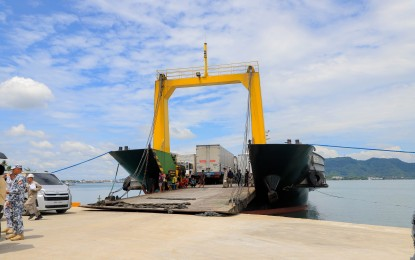

A barge transporting cargo trucks docks at Amandayehan Port in Basey, Samar, in this June 8, 2025 photo. Department of Transportation Secretary Vince Dizon advocates for a 24-hour barge operation to reduce long queues caused by the San Juanico Bridge crisis. (Photo courtesy of DPWH)
BASEY, Samar – Department of Transportation (DOTr) Secretary Vince Dizon is pushing for a 24-hour barge operation between the ports of Basey, Samar, and Tacloban to alleviate persistent long queues of cargo trucks.
On Sunday, Dizon expressed concern over the significant backlog of trucks on both sides, just a day after Amandayehan Port in Basey commenced barge services. Currently, only Santa Clara Shipping Corp. (operations began June 7) and ALD Sea Transport (first voyage June 8) serve the route on a limited 12-hour schedule, from 5 a.m. to 5 p.m.
To enable round-the-clock operations and effectively double trips, the DOTr chief ordered the Philippine Coast Guard to install navigational buoys along the San Juanico Strait. These buoys will facilitate safe nighttime RoRo operations, with the goal of achieving 24/7 service by Thursday or Friday.
Two more companies, Roble Shipping, Inc. and GT Express Shipping Corp., have also expressed interest in serving the route.
The DOTr chief admitted the response pace has been slow, more than three weeks after the San Juanico Bridge crisis stranded thousands of heavy vehicles bound for Luzon and Mindanao.
“I find the response slow; now we must make it as fast as we can. The opening of a new route will somehow ease congestion,” Dizon said. His return to Amandayehan Port after two weeks confirmed compliance with his directive to improve the wharf for RoRo operations within 10 to 15 days, with improvements completed on June 6.
The Amandayehan-Tacloban route is a new shipping lane that complements existing ones, significantly reducing travel time to 15 to 20 minutes, including loading and unloading.
This allows for up to 10 trips in 12 hours, a stark contrast to the 13-hour Calbayog-Ormoc route. Shipping companies are prioritizing trucks with dangerous, essential, and perishable goods on a first-come, first-served basis. (PNA)