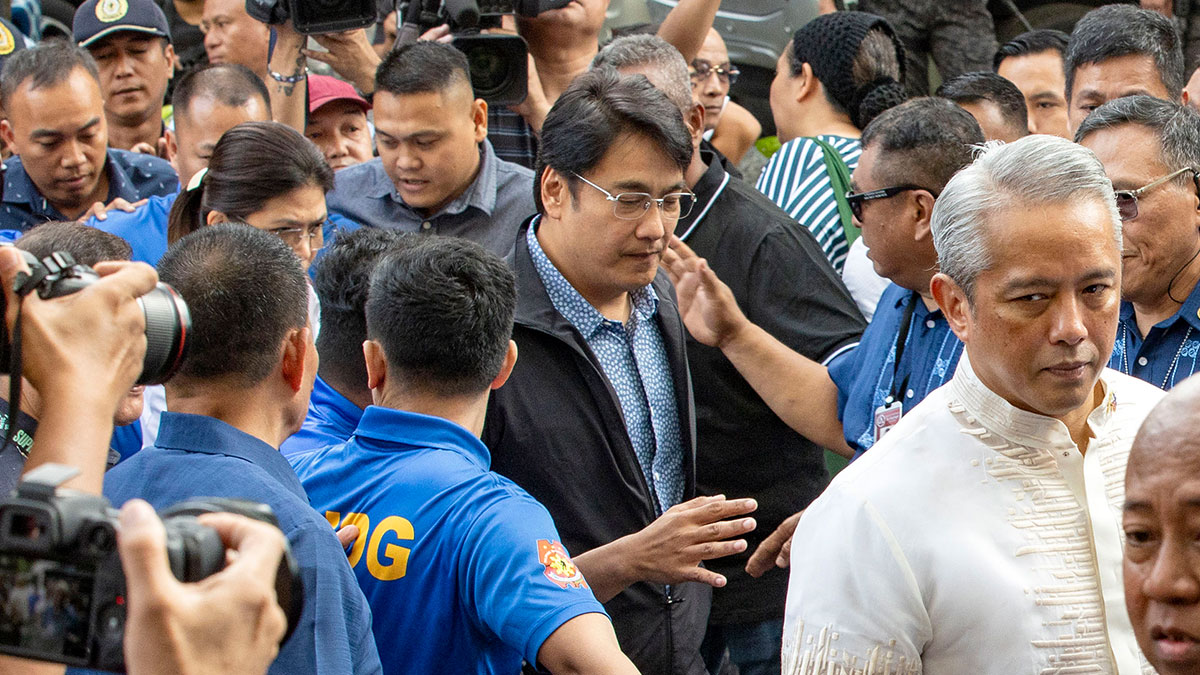

Former senator Ramon Bong Revilla Jr. and six former officials of the Department of Public Works and Highways (DPWH) Bulacan 1st District Engineering Office have rejected any possibility of a plea bargain in their ongoing graft case, signaling a full-blown courtroom battle over the alleged P92.8-million “ghost” flood control project in Pandi, Bulacan.
During proceedings before the Sandiganbayan Fourth Division, defense lawyers confirmed they were not exploring negotiated settlements with state prosecutors. The anti-graft court had inquired whether the accused were open to a plea arrangement — a legal mechanism that allows defendants to plead guilty to a lesser offense in exchange for reduced penalties — but the response was categorical: no deal.
Revilla’s counsel told the court they intend to abide by its rulings and are prepared to move forward under what they described as an impartial judicial process. The statement came after the court denied earlier motions filed by the defense, effectively narrowing the path ahead to pretrial and eventual trial.
The case stems from allegations that flood control projects funded in Bulacan were either unimplemented or irregularly executed, despite millions in public funds reportedly being released. Prosecutors have linked Revilla to the controversy through claims that he endorsed the projects and allegedly received kickbacks, accusations he has consistently denied.
The Fourth Division, chaired by Associate Justice Michael Musngi, entered a plea of not guilty on Revilla’s behalf after he declined to personally enter a plea during arraignment. His co-accused — Assistant Engineer Brice Hernandez, Engineers Jaypee Mendoza and Arjay Domasig, Engineer Emelita Juat, Christina Pineda, and Juanito Mendoza — had earlier pleaded not guilty to the graft charge.
Parallel proceedings are also unfolding before the Sandiganbayan Third Division, where the same group faces a separate malversation case. All accused except Revilla and Juanito Mendoza have already entered not guilty pleas in that branch. The arraignment for the two remaining respondents in the malversation case has been rescheduled.
The court has deferred the pretrial set for February 19 pending the continuation of the preliminary conference, where both sides are expected to finalize documentary exhibits, identify witnesses, and agree on undisputed facts.
By rejecting plea negotiations, Revilla and the DPWH officials are effectively placing their defense squarely before the court, betting on acquittal rather than compromise. Legal analysts note that declining a plea bargain can be a strategic move — especially in high-profile cases — as it avoids any admission of wrongdoing and preserves political and reputational standing.
With multiple divisions of the Sandiganbayan now handling interconnected charges, the proceedings are poised to test not only the strength of the prosecution’s evidence but also the durability of the defense’s strategy.
As the trial phase looms, attention turns to whether the government can substantiate claims that millions in taxpayer funds were diverted to projects that existed only on paper — and whether the former senator and public works engineers can dismantle those allegations in open court.