
In a country where quality education often comes with a price tag, the Polytechnic University of the Philippines (PUP) is proving that academic excellence doesn’t have to break the bank. Once seen as merely a “masa” university, PUP has steadily risen through the ranks, earning its rightful place as one of the top institutions in the country—and now, the world is taking notice.
PUP now proudly sits at #5 among the best universities in Manila and ranks #14 in the Philippines. These aren’t just numbers—they reflect decades of dedication to public service, academic rigor, and an unrelenting pursuit of accessible, high-quality education. With a selective 40% acceptance rate and a legacy that dates back to 1904, the Sintang Paaralan is finally receiving the recognition it has long deserved.
A champion for the underserved
PUP’s appeal lies in its unshakeable commitment to democratizing education. As tuition rates skyrocket across private institutions, PUP remains a refuge for deserving yet underprivileged students. It offers not only affordability but also quality that can rival—and often outperform—many elite institutions.
Its alumni are living proof. For years, PUP graduates have consistently topped employer preference surveys, often outranking those from the University of the Philippines and top-tier private schools. These graduates—many the first in their families to earn a degree—now serve in key roles across government, industries, and communities both here and abroad.
Why the NPU Bill matters
Despite its accomplishments, PUP faces a critical crossroads. The long-sought National Polytechnic University (NPU) Bill—meant to secure sustainable funding and strengthen institutional autonomy—has once again been vetoed. This isn’t just a bureaucratic blow; it’s a denial of the basic right to expand access to quality public education.
The proposed bill wasn’t about prestige. It was about survival and progress—securing ₱100 million annually for five years to ensure PUP’s infrastructure, academic programs, and satellite campuses are properly supported. These funds would have modernized facilities, stabilized staff employment, and fortified the university’s capacity to serve marginalized communities across Luzon.
Now, many of PUP’s provincial campuses, such as those in Quezon, Cavite, Batangas, and Bataan, face the threat of closure due to limited national support—despite their legal mandates under Presidential Decree No. 1341 and continued high performance in licensure and accreditation benchmarks.
Rising despite roadblocks
Even without the formal NPU status, PUP’s trajectory speaks volumes.
- The university earned a 3-star rating from the Quacquarelli Symonds (QS) international ranking body.
- It leaped 20 places in the 2025 World University Rankings for Innovation (WURI), now securing the 250th spot globally.
- The Times Higher Education (THE) Impact Rankings placed PUP in 16 out of 17 Sustainable Development Goals, highlighting its excellence in Quality Education, No Poverty, Gender Equality, and Reduced Inequality.
- Locally, its programs are backed by Level III accreditation from the AACUP.
- Its anti-corruption efforts and administrative efficiency are also lauded, with a 100% complaint resolution rate under the 8888 program and a forthcoming Philippine Quality Award from the Office of the President.
These are not just accolades—they are proof that PUP consistently performs on par with, if not beyond, the country’s most well-funded universities.
Not just for the elite
PUP’s case challenges a longstanding notion in Philippine education: that prestige belongs only to the elite. Its brand of education is rooted in service, humility, and resilience. It produces not just professionals, but principled leaders who understand the value of hard work, community, and equity.
The failure to pass the NPU Bill undermines these values. It reflects a broader failure to prioritize inclusive education and limits the university’s ability to reach the students who need it most.
A call to action
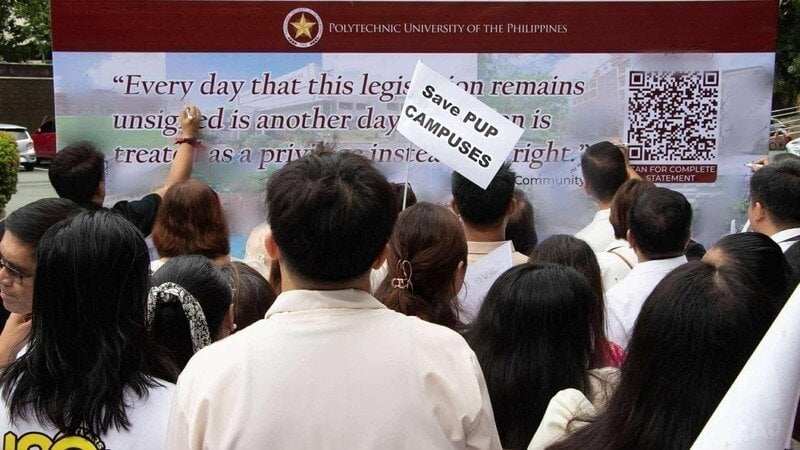
The PUP community isn’t backing down. Faculty, students, alumni, and allies are rallying behind a renewed call to pass the NPU Bill and secure the university’s future. It’s not just about one school—it’s about standing up for a vision of public education that is accessible, excellent, and truly transformative.
“We are losing time, losing minds, and losing futures,” reads a statement from the university. But more than a lament, it’s a rallying cry—a reminder that the fight for equitable education is far from over.
PUP has already proven its worth. Now it’s time for the government and the nation to respond in kind.