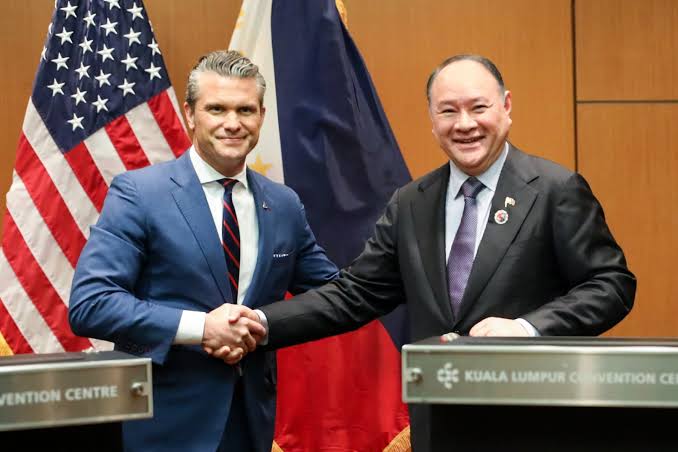

The Philippines and the United States reaffirmed their commitment to strengthening maritime security, defense cooperation, and military interoperability during the ASEAN-United States Defense Ministers’ Informal Meeting (DMIM) held in Cebu.
Defense Secretary Gilberto Teodoro Jr. and US Secretary of War Pete Hegseth led discussions on expanding defense cooperation and addressing emerging security challenges in Southeast Asia.
The meeting took place on the sidelines of the 20th ASEAN Defence Ministers’ Meeting (ADMM) and the 13th ADMM-Plus, which brought together defense officials from ASEAN member states and dialogue partners.
During the discussions, Teodoro emphasized the importance of sustained regional dialogue and cooperation in maintaining peace, stability, and security across Southeast Asia.
He also acknowledged the role of the United States in supporting regional stability, particularly through defense partnerships and cooperation with ASEAN countries.
Among the areas highlighted were maritime security, joint aerial activities, and improved interoperability among defense forces to enhance coordination and operational readiness.
The discussions underscored the importance of strengthening cooperation in responding to shared maritime and regional security challenges.
The meeting also provided an opportunity for ASEAN defense officials and their American counterparts to exchange views on regional security developments and explore ways to deepen defense engagement.
The Philippines has continued to pursue stronger defense partnerships with the United States and other regional allies as part of its efforts to modernize its armed forces and enhance maritime security capabilities.
The ASEAN-US defense dialogue formed part of broader discussions aimed at reinforcing regional cooperation, maintaining stability, and promoting a rules-based security environment in Southeast Asia.