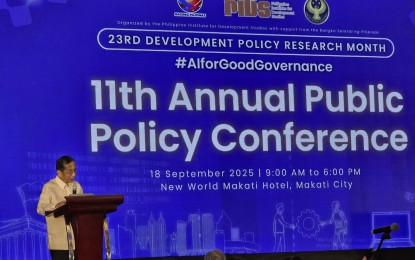

Department of Economy, Planning and Development (DEPDev) Secretary Arsenio Balisacan delivers his keynote address at the 11th Annual Public Policy Conference (APPC), hosted by the Philippine Institute for Development Studies, at the New World Makati Hotel in Makati City on Thursday (Sept. 18, 2025). Balisacan emphasized the importance of leveraging artificial intelligence (AI) in promoting good governance, enhancing service delivery, and propelling the country’s transition to a digital economy. (PNA photo by Benj Bondoc)
The Philippines is setting the stage for a major transformation powered by artificial intelligence (AI) to accelerate national development and improve the quality of life for all Filipinos, according to Department of Economy, Planning and Development (DEPDev) Secretary Arsenio Balisacan.
In his keynote at the 11th Annual Public Policy Conference of the Philippine Institute for Development Studies (PIDS) in Makati City, Balisacan highlighted the country’s progress in its digital shift. He noted that the digital economy expanded to PHP2.1 trillion in 2024 from PHP1.6 trillion in 2018, while the country climbed to 56th place in the Oxford Government AI Readiness Index 2024 with a score of 58.5, up from 65th place and 51.98 the year before.
“These gains affirm that Filipinos are not only adopting technology—we are shaping it to secure our future,” Balisacan said, emphasizing that the government is committed to building inclusive digital infrastructure, strengthening human capital through education and reskilling, enhancing governance rooted in ethics and trust, and fostering collaboration across government, academe, private sector, and civil society.
He said the National Innovation Agenda and Strategy Development, aligned with the Philippine Development Plan 2023–2028, places innovation at the center of economic growth. Among the key initiatives anchored on this agenda are the Department of Trade and Industry’s AI Strategy Roadmap 2.0, which establishes the Center for AI Research, and the Department of Education’s efforts to integrate AI literacy in schools.
Other notable projects include the Department of Science and Technology’s Democratized Intelligent Model Exchange Repository (DIMER), which offers ready-to-use AI models for agriculture, disaster response, and industry, and the Department of Information and Communications Technology’s SPARK initiative with Google to scale up free AI training nationwide. The government has also rolled out the eGov PH app, and over 88.5 million Filipinos can now access their digital national IDs, while 55 million physical IDs have been delivered.
Balisacan said the National Fiber Backbone currently connects six regions and 17 million people, while the newly enacted Konektadong Pinoy Act aims to increase competition, lower costs, and expand access to telecom services. He also cited joint guidelines by the DICT and Civil Service Commission promoting ethical and trustworthy AI use in government, as well as the need to pair AI adoption with green energy standards.
“Consider good governance—AI can detect anomalies in procurement, reduce bureaucratic friction, and prevent fraud,” he said, adding that AI could also be used to develop assistive technologies to enhance healthcare and social inclusion, especially as the country braces for an aging population by 2030.
“The age of AI is not about replacing humanity, it is about enriching it,” Balisacan said. “It is about combining human and artificial intelligence to make governance inclusive, transparent, and resilient. Let us not remain spectators as the world advances. Let us lead with vision, build with purpose, and innovate with heart.”