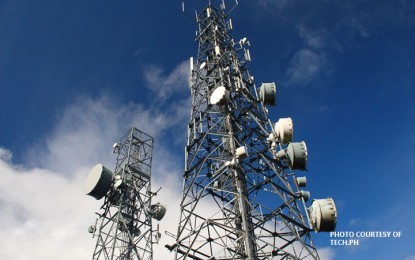

A telecommunication tower in this undated photo. The Philippine Chamber of Commerce and Industry on Thursday (Sept. 18, 2025) said amendments to the Public Service Act, SIM Card Registration Law, the Digital Transformation Roadmap and the National Fiber Backbone are “steps in the right direction” but more needs to be done to ensure that the Philippines will speed ahead on its digital transformation. (File photo courtesy of Tech.PH)
The Philippine Chamber of Commerce and Industry (PCCI) on Thursday lauded recent government initiatives supporting the country’s digital shift, while urging stronger action to ensure that digital transformation reaches rural and underserved communities.
In a statement, PCCI cited the amended Public Service Act, SIM Card Registration Law, the Digital Transformation Roadmap, and the National Fiber Backbone as “steps in the right direction.” These measures, the group said, lay the groundwork for improving the country’s digital infrastructure.
However, PCCI president Consul Enunina Mangio stressed that achieving inclusive and sustained growth requires leveling the digital playing field between urban centers and far-flung areas.
“If we are to achieve inclusive and sustained growth, local governments, schools, and enterprises in rural areas must have the same level of access and reliability as their urban counterparts. And to be competitive, cost and speed must be equivalent or even better than those of our neighbors in ASEAN who are already years ahead of us in MSME digitization, e-commerce adoption, and digital government services,” Mangio said.
To bridge this gap, the group called for a series of measures: expanding last-mile connectivity in remote areas through targeted investments and public-private partnerships; fast-tracking telecom infrastructure rollout by streamlining permits for towers and fiber ducts; enforcing infrastructure-sharing policies; prioritizing national broadband projects; fostering competition and affordability through spectrum management to accelerate 5G rollout; and supporting localized community networks and digital hubs with incentives for open-access models.
PCCI director for ICT Dennis Anthony Uy added that connectivity should be treated “as a critical infrastructure, on par with roads, energy, and ports,” emphasizing the need for more strategic investments in both fixed and mobile broadband networks.
“Open, affordable, and nationwide connectivity will not just future-proof our economy—it will empower every Filipino to take part in that future starting today,” Uy said.