
The Philippine economy is bracing for a slower-than-expected climb in the next two years as the Asian Development Bank (ADB) trims its growth projections, reflecting growing global headwinds that are beginning to cast a longer shadow on the region’s economic trajectory.
According to ADB’s latest Asian Development Outlook report released this July, the Philippines is now expected to grow by 5.6 percent in 2025 and 5.8 percent in 2026—both down from previous estimates of six percent and 6.1 percent, respectively. The adjustment mirrors mounting pressure from a mix of global trade tension, inflationary volatility, and subdued export performance.
The ADB cited escalating trade disputes, particularly between the United States and major Asian economies, and an overall cooling of global demand as key factors dampening the economic outlook not only for the Philippines but for much of developing Asia.
“External challenges are piling up, and their ripple effects are increasingly visible across the region,” said ADB Chief Economist Albert Park. “To navigate these turbulent times, economies like the Philippines must double down on strengthening internal resilience and reinforcing trade relationships within the region.”
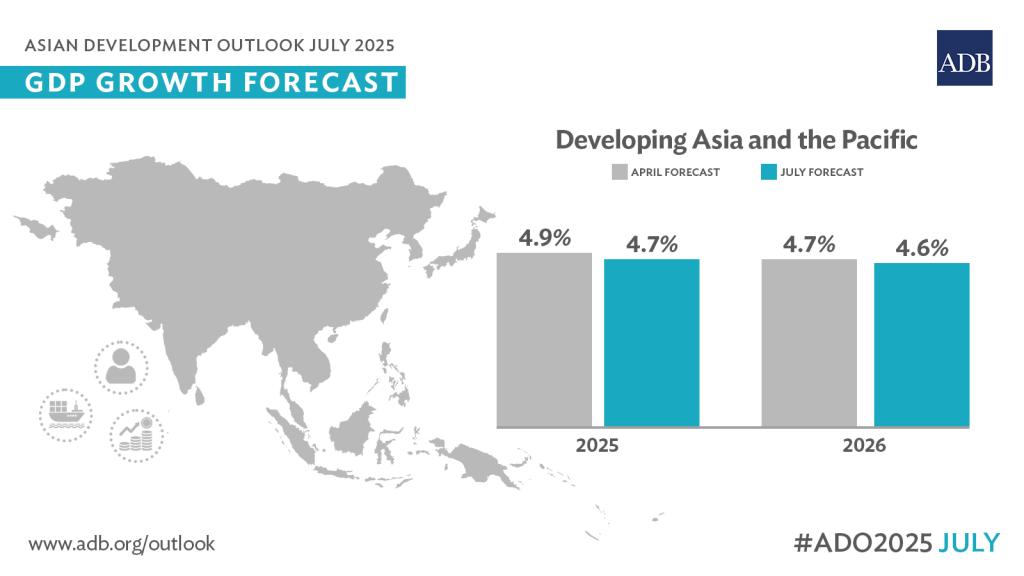
Beyond the Philippines, the broader Asia-Pacific region is also set for a more modest economic ride. ADB now forecasts a regional growth of 4.7 percent in 2025 and 4.6 percent in 2026, shaving off 0.2 and 0.1 percentage points from earlier projections. Southeast Asia, in particular, is expected to be hit hardest, with growth estimates slashed to 4.2 percent and 4.3 percent for the next two years.
Even economic giants like India and China are not immune. India’s forecast has been nudged downward to 6.5 percent and 6.7 percent for 2025 and 2026, respectively, while China’s growth is projected to stay flat at 4.7 percent this year and slow further to 4.3 percent next year amid continued property market stress.

Yet not all regions are trending downward. ADB upgraded its projections for the Caucasus and Central Asia, attributing the bump to increased oil production. These economies are expected to grow 5.5 percent in 2025 and 5.1 percent in 2026—small bright spots in an otherwise cautious forecast.
On the inflation front, there is a silver lining. Easing oil prices and robust agricultural output have helped cool inflation across the region. The bank now expects inflation to average 2.0 percent in 2025 and 2.1 percent in 2026—both slightly lower than previously estimated.
As the world grapples with a mix of geopolitical uncertainty, softening demand, and shifting trade dynamics, ADB urged governments in the region to prioritize economic diversification, invest in infrastructure, and deepen regional integration. These strategies, it said, will be essential to counterbalance global volatility and unlock longer-term growth.
ADB, headquartered in Manila, has long played a pivotal role in promoting sustainable and inclusive development throughout Asia and the Pacific. With a network of 69 member countries, the bank continues to support economies in weathering crises and building resilient futures.
As global currents shift, the Philippines—and its regional peers—face a pivotal moment: adapt boldly or risk being swept aside in a fast-changing economic tide.