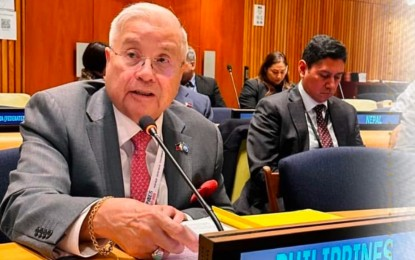

Philippine Permanent Representative to the United Nations Antonio Lagdameo during the Third Meeting of States Parties to the Treaty on the Prohibition of Nuclear Weapons (TPNW) on March 3, 2025 (US time). The meeting was convened in New York and will run from March 3 to 7. (Photo courtesy of the Philippine Permanent Mission to the UN in New York)
The Philippines has reiterated its call for more nations to ratify the Treaty on the Prohibition of Nuclear Weapons (TPNW), emphasizing the “urgent need” to universalize the agreement.
Philippine Permanent Representative to the United Nations, Antonio Lagdameo, renewed the country’s appeal during the Third Meeting of States Parties to the TPNW in New York on March 3 (U.S. time).
“Nuclear weapons pose an unacceptable risk to humanity and our environment—a fact repeatedly confirmed by scientific research and historical evidence,” Lagdameo stated while delivering the Philippine position.
He stressed that the well-documented humanitarian and environmental consequences of nuclear weapons should prompt the global community to “question and reject security doctrines that depend on the threat of mass destruction.”
Lagdameo reaffirmed the Philippines’ steadfast commitment to the treaty and its advocacy for broader international participation.
“The Philippines remains dedicated to working collaboratively with all nations to achieve a world free of nuclear weapons,” he said. “In these challenging times, fostering trust and building bridges among nations is not just beneficial—it is essential for our collective security and prosperity.”
Lagdameo also welcomed Indonesia, Sierra Leone, and the Solomon Islands as the latest states to join the treaty, noting that their commitment strengthens the global consensus against nuclear weapons and brings the world closer to universal adoption of the agreement.
The TPNW establishes a comprehensive framework prohibiting various nuclear-related activities, including the development, testing, production, acquisition, and possession of such weapons.
The treaty officially took effect in January 2021, following the deposit of the 50th instrument of ratification or accession in October 2020.
The treaty has 94 signatories and 73 state parties, including the Philippines.