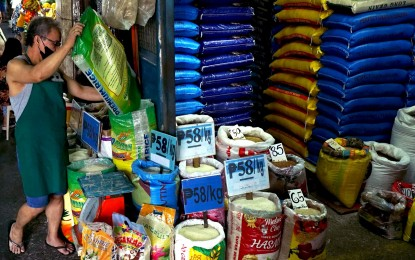

A worker refills the premium rice stock at a rice stall in Kamuning Market, Quezon City on Jan. 20, 2025. Agriculture Secretary Francisco Tiu Laurel Jr. on Wednesday (March 5, 2025) said the deflation of rice prices in January reflects the effectiveness of the measures the Marcos administration has been implementing to stabilize the staple food prices in the country. (PNA photo by Ben Briones)
Department of Agriculture (DA) Secretary Francisco Tiu Laurel Jr. announced on Wednesday that the decline in rice prices in January reflects the success of the Marcos administration’s initiatives to stabilize the cost of the staple food in the Philippines.
The Philippine Statistics Authority (PSA) reported that rice inflation in January was recorded at -2.3 percent year-on-year, the lowest since June 2020, which saw a -2.8 percent decline. This marks the first deflation in rice prices since the slight drop of 0.1 percent in December 2021.
“This is welcome news. It clearly demonstrates that President Bongbong Marcos’ efforts, particularly last year’s significant tariff reductions, are yielding positive results,” Tiu Laurel stated.
Inflation decline and rice price drop
The PSA further reported that overall inflation slowed to 2.1% in February from 2.9% in January, primarily due to decreased price increases for food and non-alcoholic beverages.
Rice prices, in particular, experienced a sharper deflation of 4.9%, attributed to declining international costs and reduced tariffs. DA spokesperson Assistant Secretary Arnel de Mesa noted that rice prices have fallen since December 2024.
“This is the result of the DA’s combined programs. Through our ‘Rice for All’ initiative, we have reduced prices from P45 to P35,” De Mesa said in a media interview.
The ‘Rice for All’ program provides well-milled rice to the public via Kadiwa ng Pangulo (KNP) Centers and kiosks in selected public markets, as well as Light Rail Transit (LRT) and Metro Rail Transit (MRT) stations.
Price regulation and future projections
De Mesa also credited setting a maximum suggested retail price (MSRP) for imported rice as a contributing factor in stabilizing prices. “The MSRP implementation has prevented prices from reaching P60 per kilogram,” he added.
The current MSRP for 5% broken rice is set at P49 per kilogram, with projections to decrease further to P45/kg by the end of March. Before the implementation of the MSRP, retail prices ranged between P62/kg and P64/kg.
Expected impact of food security emergency
The government anticipates that the recently declared food security emergency will begin to make a tangible impact this March.
“It hasn’t taken full effect yet, but by this month, we expect to see further reductions,” De Mesa stated.
Under the food security emergency declaration, the National Food Authority (NFA) is authorized to distribute rice stocks to local government units (LGUs) through the DA and Food Terminal Incorporated (FTI) at P33/kg and sell them to consumers at P35/kg.
So far, San Juan, Navotas, and Camarines Sur have secured rice procurement from the DA-FTI, while 70 other LGUs have expressed interest in purchasing NFA rice.
With continued tariff reductions, price regulations, and government initiatives, authorities remain optimistic about maintaining rice price stability and ensuring affordability for Filipino consumers.