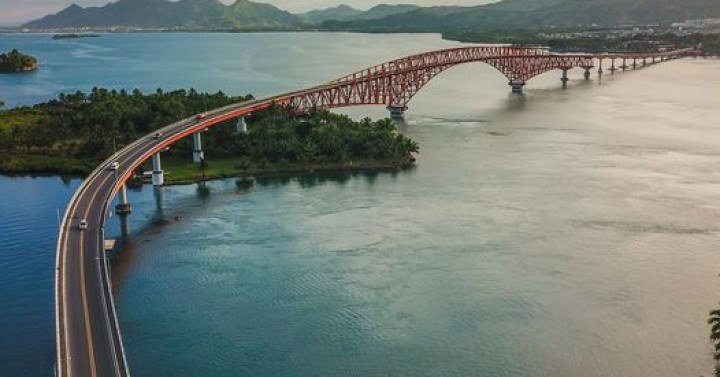
The National Disaster Risk Reduction and Management Council (NDRRMC) has reported that approximately ₱7 billion is required to repair and rehabilitate the San Juanico Bridge, citing growing concerns over the structure’s integrity and safety.
“The estimated cost of repair and rehabilitation by the DPWH amounts to P7 billion, and any delay in fund release would further escalate the crisis,” the NDRRMC said.
The NDRRMC has warned that limitations on the use of the San Juanico Bridge could lead to economic losses of up to ₱600 million per month. The bridge, which serves as a vital link in the region, accommodates around 14,000 vehicles daily, making its rehabilitation critical to maintaining the flow of goods and people.
“The abrupt imposition of restrictions has stranded more than 200 vehicles and is projected to result in monthly economic losses ranging from P300 million and P600 million,” the NDRRMC said.
The potential restrictions on San Juanico Bridge are expected to significantly impact key sectors, including the supply and transport of food and fuel, delivery of healthcare services, commercial goods distribution, and overall regional trade.
In response to growing concerns over the deteriorating condition of the San Juanico Bridge, NDRRMC called on President Ferdinand “Bongbong” Marcos Jr. to declare a state of calamity across the Eastern Visayas region. This recommendation follows the earlier declaration of a state of emergency in Tacloban City and Samar Province.
Built in 1972, San Juanico Bridge remains the only permanent land connection between Samar and Leyte. As part of the Maharlika Highway, it serves as a critical link uniting Luzon, Visayas, and Mindanao.
However, recent structural assessments have revealed serious damage, prompting authorities to impose a three-ton load limit starting May 15.
Currently, only the center span of the bridge is open to motorists. This restriction has halted the movement of heavy cargo trucks, severely affecting the delivery of essential goods such as food, medicine, agricultural supplies, and construction materials. The disruption has further amplified the economic strain in the region, with the NDRRMC estimating potential monthly losses at ₱600 million.