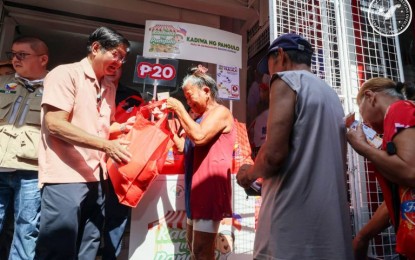
Since its launch in May, President Ferdinand R. Marcos Jr.’s initiative to provide PHP20 per kg of rice to vulnerable sectors has benefitted close to a million Filipinos, according to a report from the Department of Agriculture (DA) on Tuesday.
The subsidized rice, offered under the “Benteng Bigas Meron (BBM) Na!” program, is available to senior citizens, persons with disabilities, solo parents, beneficiaries of the Pantawid Pamilyang Pilipino Program (4Ps), the Walang Gutom Program, and minimum wage earners.
As of July 14, a total of 2,105 metric tons (MT) of subsidized rice have been sold to 217,614 households. DA spokesperson Assistant Secretary Arnel De Mesa noted, “At 217,000 households already benefitting at four persons per household, we’re almost hitting 1 million total beneficiaries for the Benteng Bigas Meron program.”
The PHP20 per kg rice is currently available in 162 out of the 699 operational Kadiwa ng Pangulo (KNP) centers and stores nationwide, including various regions such as Metro Manila, the Cordillera region, Ilocos region, Cagayan Valley, Central Luzon, Calabarzon, Mimaropa, Bicol region, Western Visayas, Central Visayas, Eastern Visayas, Zamboanga Peninsula, Northern Mindanao, Davao region, Soccsksargen, and Caraga.
De Mesa mentioned that more local government units (LGUs) are finalizing details to implement the BBM Na program, with a target of establishing 1,500 sites by the end of 2028. The DA was initially allocated PHP4.5 billion from the contingency fund of the Office of the President to roll out the program, aiming to reach 15 million beneficiaries.
The supply of rice for the program comes from the National Food Authority (NFA), which purchases palay from local farmers at PHP17 per kg for fresh and wet palay and up to PHP24 per kg for clean and dry palay. Partner agencies include the Philippine Postal Corp. (PHLPost), the Department of Labor and Employment (DOLE), the Department of Migrant Workers (DMW), and the Department of Social Welfare and Development (DSWD).
Malacañang has expressed optimism that all Filipinos, not just vulnerable sectors, will be able to purchase PHP20 per kg of rice by 2026.
Taming Rice Inflation
In addition to the BBM Na program, the Marcos administration has implemented various measures to control the retail price of rice and ensure public welfare. These measures include Executive Order (EO) 62, which reduced tariffs on imported rice from 35 percent to 15 percent, the gradual reduction of the maximum suggested retail price (MSRP) for 5 percent broken imported rice, the declaration of a food security emergency for rice, and the availability of the Rice for All (RFA) program.
De Mesa stated, “This is the cause or major reason for the significant drop in food inflation, because of the decline in retail prices of rice varieties.” As of July 14, the price per kg of imported premium rice in Metro Manila ranges from PHP45 to PHP46, while local premium rice ranges from PHP46 to PHP57.
The MSRP for 5 percent broken rice was initially set at PHP58 per kg and has now been reduced to PHP45 per kg, with plans to lower it to PHP43 per kg on July 16. The RFA program includes various rice types, such as RFA 5, selling at PHP43 per kg, RFA 25 at PHP35 per kg, and RFA 100 at PHP33 per kg.
Before government interventions, retail rice prices in Metro Manila ranged from PHP60 to PHP70 for special premium-grade rice in early July 2024. Data from the Philippine Statistics Authority indicated that rice inflation persisted beyond the government’s 4 percent target, peaking at over 20 percent in several months during 2024.