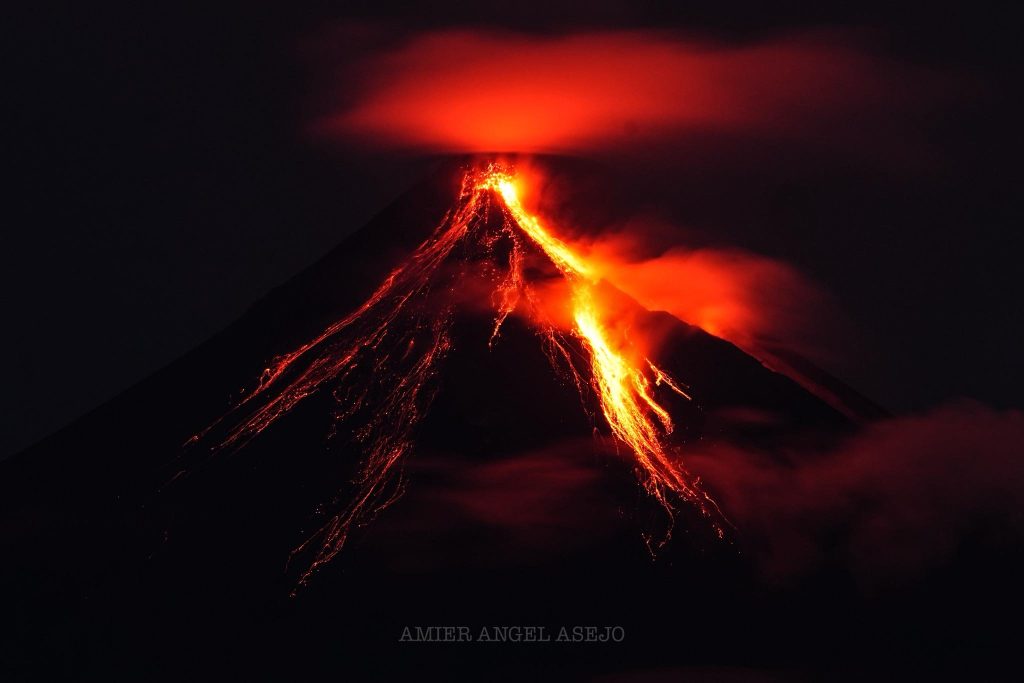

(Image courtesy of Amier Angel Asejo/Office of the Governor of Albay)
Mayon Volcano remains under Alert Level 3 as it continues to exhibit intensified magmatic unrest, the Philippine Institute of Volcanology and Seismology (Phivolcs) reported Saturday, citing ongoing lava effusion, elevated gas emissions, and persistent surface hazards.
Phivolcs said Mayon’s current activity is characterized by the growth of a lava dome and continuous lava flow effusion, confirming that magma has reached the surface and is actively being discharged. This places the volcano in a state of heightened unrest, warranting strict enforcement of safety restrictions around the edifice.
Over the past monitoring period, the agency recorded 261 rockfall events and 29 pyroclastic density currents, indicating frequent collapse of unstable volcanic material from the summit area. Crater glow was also observed and classified as fair and visible to the naked eye, further signaling active magmatic processes at shallow levels.
Despite the absence of recorded volcanic earthquakes in the last 24 hours, Phivolcs noted that the lack of seismicity does not diminish the ongoing hazard, as surface activity remains pronounced. Ground deformation data continue to show inflation of the volcanic edifice, suggesting sustained pressurization beneath the volcano.
Sulfur dioxide emissions remained high, with Phivolcs measuring 6,110 tonnes per day on January 23. Gas plumes were observed at moderate levels, drifting toward the southwest depending on prevailing wind conditions.
Given these conditions, Phivolcs reiterated that entry into the six-kilometer radius Permanent Danger Zone is strictly prohibited. The agency also warned against entry into the Extended Danger Zone without heightened vigilance and emphasized that aircraft should not fly close to the volcano due to the risk of ash and sudden explosive activity.
Under Alert Level 3, Mayon may generate a range of hazardous phenomena, including rockfalls, landslides, ballistic fragments, lava flows and lava fountaining, pyroclastic density currents, and moderate-sized explosions. Phivolcs also cautioned that heavy and prolonged rainfall could trigger lahars along existing channels.
Mayon Volcano is located in the province of Albay. Phivolcs said round-the-clock monitoring continues and advised the public, local governments, and disaster response agencies to remain alert and to rely only on official bulletins, hazard maps, and preparedness materials available through its official platforms.