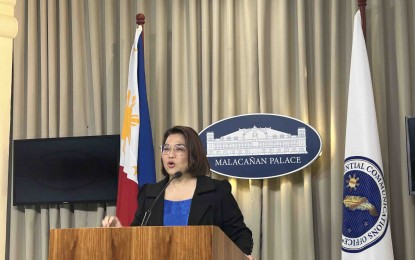

Palace Press Officer Claire Castro (PNA photo by Ruth Abbey Gita-Carlos)
In a dramatic escalation of his administration’s anti-corruption campaign, President Ferdinand R. Marcos Jr. has unleashed a high-powered independent commission to hunt down what he described as the “entrenched rot” in government flood control spending — long seen as a lucrative breeding ground for ghost projects, kickbacks, and political patronage.
Marcos on Thursday signed Executive Order No. 94 creating the Independent Commission for Infrastructure (ICI), granting it sweeping powers to investigate the alleged misuse of billions of pesos in public works funds over the past decade. The move came after the President’s public call during his last State of the Nation Address to purge corrupt officials and contractors, following his own surprise inspections that exposed substandard and even non-existent flood control projects in Bulacan and Mindoro.
On Saturday, Malacañang announced the appointment of former public works secretary Rogelio Singson and veteran certified public accountant Rossana Fajardo as ICI members, while Baguio City Mayor Benjamin Magalong will serve as its special adviser and lead investigator. The chairperson will be named in the coming days.
“Wala ni isa sa kanila ang konektado sa anumang ahensiya o kontratistang ini-imbestigahan (Not one of them is connected to any agency or contractor being investigated),” Palace Press Officer Claire Castro said. “Walang sasantuhin dito — kahit kamag-anak, kaibigan, o kaalyado (No one will be spared — not even relatives, friends, or allies). There will be no sacred cows. This clean-up begins now.”
Singson: Reformist at the frontlines
Singson, a known reformist who led a sweeping clean-up of the Department of Public Works and Highways (DPWH) during the Aquino administration, is being brought back to finish unfinished business. Under his watch, the DPWH introduced stringent anti-corruption systems, scrapped hundreds of ghost projects, and tightened procurement rules — reforms that earned him a reputation as one of the agency’s rare corruption-busters.
He later served as president and CEO of the Bases Conversion and Development Authority (BCDA), overseeing multibillion-peso infrastructure and land development projects.
“Mr. Singson’s decades of experience in planning, procuring, and executing major infrastructure projects are invaluable,” Castro said. “He knows where the system breaks down — and where the money leaks.”
Fajardo: The forensic bloodhound
Fajardo, meanwhile, currently leads SGV and Co., the country’s largest professional services firm. With more than 30 years of experience in auditing, risk management, and internal controls, she is known in the industry as a forensic financial bloodhound, with a track record of uncovering fraud and plugging systemic loopholes in both government and private institutions.
“She has helped organizations detect fraud, strengthen governance, and build accountable systems,” Castro said. “Her financial acumen will be critical in following the trail of public funds and mapping out the entire corruption chain.”
Magalong: The enforcer
Tasked to lead the investigative arm of the ICI is Magalong, the former police general whose career is marked by explosive corruption probes and institutional reforms. He was among the pioneers of intelligence-driven, forensic-based investigations inside the Philippine National Police.
“As Baguio City mayor, he has maintained strict standards of transparency and accountability,” Castro said. “His experience in penetrating organized networks of corruption and enforcing compliance makes him indispensable to this clean-up.”
Sweeping powers, tight timeline
Under EO 94, the ICI is mandated to prioritize flood control projects implemented in the past 10 years — the same period when alleged ghost projects, overpricing, and sweetheart deals flourished. The body is empowered to:
- investigate, receive, and evaluate evidence and intelligence reports on irregularities
- issue subpoenas to compel witnesses and documents
- recommend criminal, civil, and administrative charges before the DOJ, Ombudsman, and CSC
- endorse whistleblowers to the Witness Protection Program and recommend them as state witnesses
- seek asset freezes, hold departure orders, and preventive suspensions to protect the integrity of its probes
The commission can also propose sweeping corrective measures and legislative reforms to finally close the loopholes that have allowed corruption to thrive in public works.
Breaking the patronage cycle
Marcos’ crackdown marks the first time in recent history that a sitting president has assembled an independent, non-political body with such broad powers to dismantle a known hotbed of political patronage.
“This is not about politics,” Castro stressed. “This is about breaking a cycle of corruption that has bled the people dry and left them underwater — literally.”
With Singson, Fajardo, and Magalong on the frontlines, the ICI is poised to pierce the layers of collusion that have shielded corrupt operators for years — and bring down an empire of ghost projects that has turned floodwaters into cash flows for the powerful.