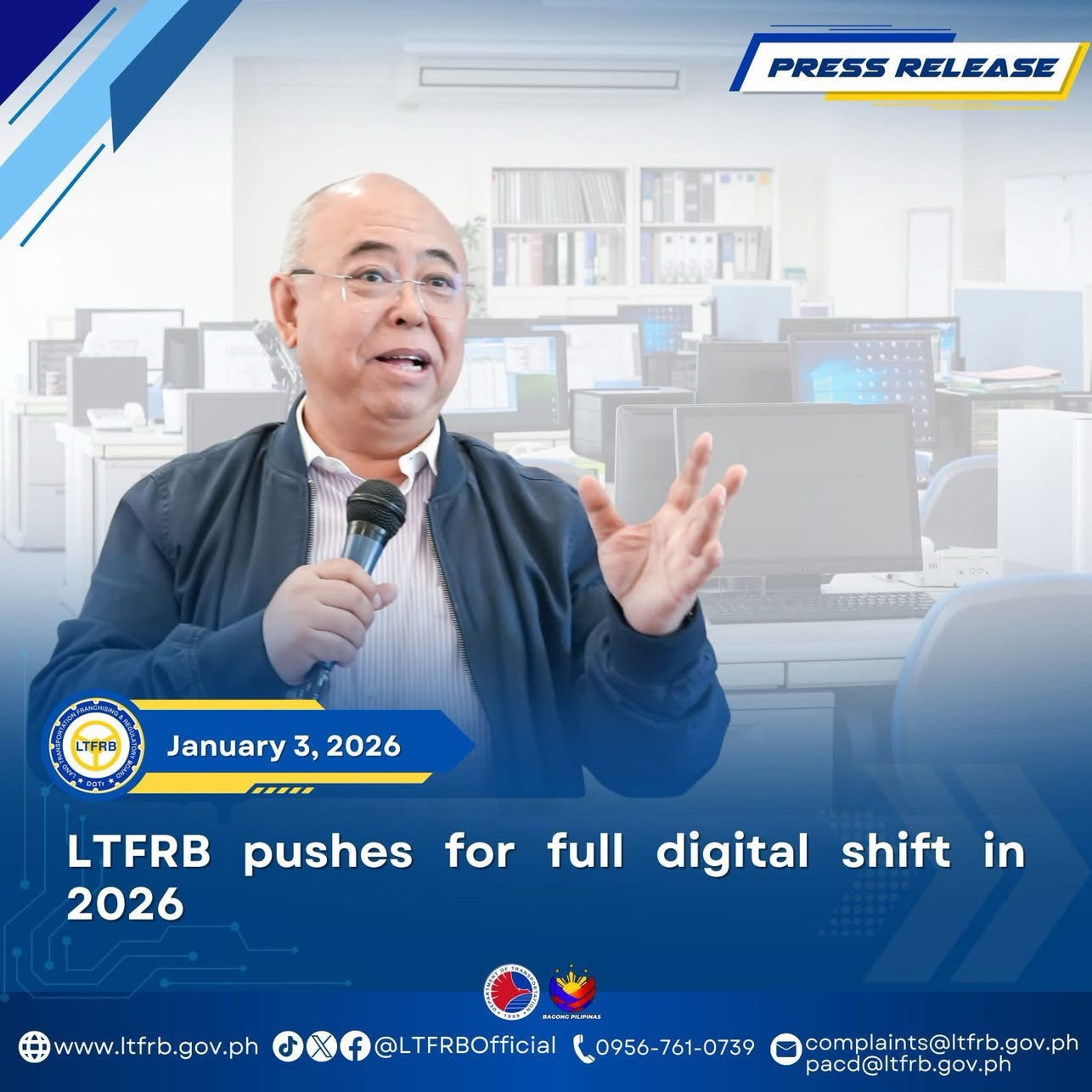

The Land Transportation Franchising and Regulatory Board is pushing for a full-scale digital transformation in 2026 as part of its broader effort to modernize the country’s public land transportation system and improve the delivery of government services.
LTFRB Chairperson Vigor D. Mendoza II said the agency is entering the new year with a clear mandate to accelerate reforms, backed by the full support of Ferdinand Marcos Jr. and guided by Giovanni Z. Lopez of the Department of Transportation.
According to Mendoza, the LTFRB is now finalizing key processes that will allow the agency to fully shift to digital platforms for most, if not all, of its transactions.
He said the goal is to implement online application and verification systems covering petitions, motions, franchise-related filings, and other transactions, aligning the agency with the President’s directive for the digital transformation of government services.
Mendoza stressed that the shift is essential in preparing the LTFRB to serve a new generation of digitally adept Filipinos who expect faster, more transparent, and more accessible public services.
The digital push is also meant to ensure full compliance with the Ease of Doing Business and Efficient Government Service Act, which seeks to cut red tape and improve efficiency across government agencies.
Mendoza noted that reducing human intervention through online systems would help address the long-standing problem of fixers, as transactions would become more direct, streamlined, and secure.
He added that the LTFRB’s digital overhaul carries symbolic weight, especially as the country moves to modernize its transport sector. As one of the key agencies implementing the Public Transportation Modernization Program, the LTFRB plays a critical role in route rationalization and fleet modernization.
Mendoza said it would be contradictory to pursue transport modernization while relying on outdated internal systems.
For this reason, the agency is pushing to implement its digital transformation alongside the PTMP, ensuring that regulatory processes evolve in step with changes on the ground. Mendoza expressed optimism that the full shift can be implemented within the year.
At present, the LTFRB is enhancing its online platform to make it more user-friendly and accessible to operators and stakeholders. The agency is also rolling out online verification for Certificates of Public Convenience and Provisional Authority, a move expected to significantly shorten the application, approval, and release process for public utility vehicle operators.
Mendoza said these reforms are aimed at building a faster, more transparent, and future-ready LTFRB that supports a modern, reliable, and efficient public transportation system for Filipinos.