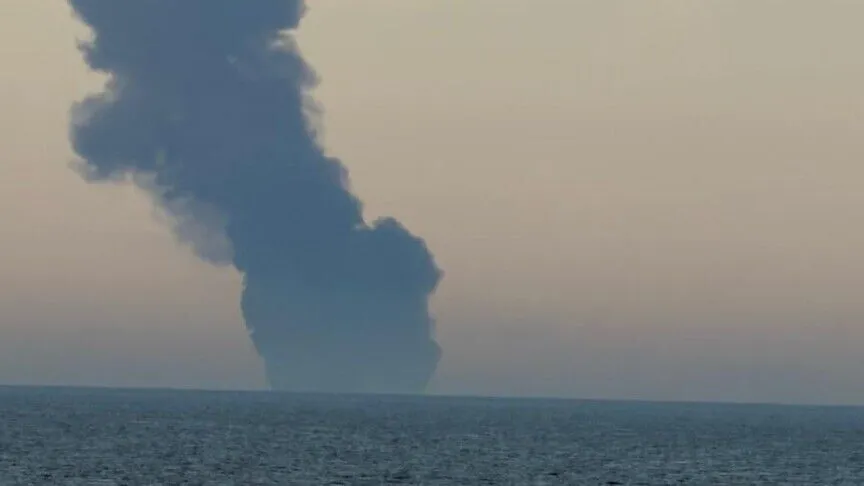

(Photo courtesy of Anadolu)
ISTANBUL – Iran’s Islamic Revolutionary Guard Corps (IRGC) claimed Wednesday that four oil tankers were destroyed after hitting naval mines while attempting to cross a restricted shipping route south of the Strait of Hormuz.
In a statement carried by Iran’s official IRNA news agency, the IRGC said the vessels caught fire following the explosions and remained ablaze.
The Iranian military force also reported detaining two other vessels for allegedly violating maritime restrictions in the strategic waterway.
The IRGC further claimed that its air defense units shot down a US-made MQ-9 drone over the Strait of Hormuz at approximately 4:30 a.m. local time (0100 GMT).
According to the statement, the drone was the 56th aircraft of its kind that Iranian forces had allegedly intercepted and destroyed.
The IRGC said the operations were conducted by its naval and aerospace forces, claiming they had inflicted “heavy blows on the enemy.”
It also warned that Iranian forces remained prepared to deliver a “final blow” against Israel and the United States.
The claims could not be independently verified.
The reported incidents came amid continuing tensions between Washington and Tehran over maritime security and a US naval blockade affecting shipping activities in the Strait of Hormuz.
Qatar has been facilitating diplomatic communications between the two countries in an effort to ease tensions and address disputes over access to the vital shipping route.
On Monday, Iranian officials said Tehran continued exchanging messages with Washington through mediators but maintained that reopening the waterway depended on the United States lifting its blockade.
The latest developments followed months of hostilities involving Iran, Israel and the United States.
On February 28, US and Israeli forces launched attacks against Iran, prompting Tehran to retaliate against Israeli targets and American military assets across the region.
A ceasefire was eventually reached in April, although disagreements over maritime security and regional military activities persisted.
Washington and Tehran subsequently signed a memorandum of understanding on June 18 concerning freedom of navigation through the Strait of Hormuz.
However, implementation of the agreement has stalled because of unresolved differences over security arrangements.
The Strait of Hormuz remains one of the world’s most strategically important maritime passages, serving as a major route for international oil shipments.
Any prolonged disruption to commercial shipping through the waterway could affect global energy supplies and international oil markets.