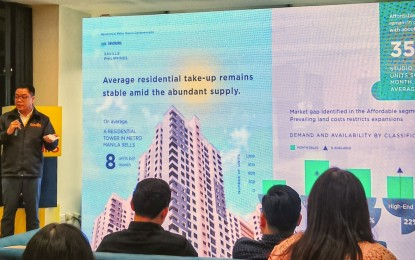

KMC Savills Research and Marketing Director Dino Palanca, in a briefing in Taguig City on Wednesday (Feb. 11, 2026), said transportation-related government infrastructure projects are helping boost demand for residential real estate properties. The drivers for office spaces demand, in turn, include healthcare and financial technology. (PNA photo by Joann Villanueva)
Major infrastructure rollouts and stronger regional connectivity are emerging as key catalysts for the Philippine property market in 2026, as developers and investors recalibrate strategies across residential, office, retail, logistics and hospitality segments.
At a recent briefing, KMC Savills executives underscored how transport projects that cut travel time and integrate business hubs are reshaping demand patterns and unlocking new growth corridors beyond Metro Manila.
Dino Palanca, Director of Research and Marketing at KMC Savills, noted that residential inventory has tightened after developers shifted focus to other segments following a period of oversupply.
He said new residential developments continue to gain traction in growth areas such as Cavite, Laguna, Batangas and Rizal, as well as Pampanga, which is increasingly being viewed as a viable extension market despite its distance from the capital.
“The drivers are evident. We’re grateful that the government also has stepped in to play in building infrastructure projects and interconnecting businesses altogether,” Palanca said. “Apart from making travel and business easier, it connects us regionally to a more direct range of opportunity.”
The result is a more decentralized residential landscape, where buyers are weighing affordability, accessibility and lifestyle in emerging provincial hubs that are now better linked to Metro Manila’s economic core.
In the office sector, demand remains resilient, supported by evolving segments within the IT-BPM ecosystem.
John Corpus, Executive Director for Tenant Representation, identified healthcare, financial technology, information technology, game development and robotics as key drivers of office space take-up. These sectors, many of which operate within the broader information technology-business process management industry, continue to anchor demand for flexible, tech-ready office environments.
Retail, meanwhile, is undergoing a structural recalibration. Alex Samuel, Director for Consultancy and Valuation, said operators are pivoting back to larger, more traditional formats after smaller concepts such as food carts and micro-branches failed to scale as quickly as anticipated.
“Traditional formats that have a larger type of scale are more stable for retailers,” Samuel said, signaling a renewed preference for big-box supermarkets and expansive commercial footprints that offer operational efficiency and consistent foot traffic.
Supporting this shift is the rapid expansion of logistics infrastructure.
Ninoy Tea, Executive Director for Investment Services, pointed to exponential growth in warehousing, distribution centers and logistics hubs — a trend expected to sustain momentum over the next five to 10 years.
“We’ve seen the growth of logistics hubs exponentially. We feel that it will continue to grow in the next five to 10 years,” Tea said.
The boom in logistics not only strengthens e-commerce and supply chains but also reinforces demand for industrial land and retail-adjacent facilities, creating a multi-layered impact across property subsectors.
In hospitality, new pockets of opportunity are emerging outside traditional tourism strongholds. Subic in Zambales is seeing increased demand for hotels and accommodations linked to military exercises and related activities, while Bohol continues to benefit from sustained tourism interest.
Policy reforms, however, remain critical to sustaining investor confidence.
KMC Savills executives emphasized the need to lift the moratorium on new economic zones in Metro Manila accredited by the Philippine Economic Zone Authority, expand incentives for tenants aligned with green and sustainability initiatives, and provide greater leeway on foreign ownership to bolster manufacturing investments.
Taken together, the message from industry leaders is clear: infrastructure connectivity, sectoral diversification and forward-looking policy adjustments are converging to redefine the Philippine real estate landscape. As travel becomes easier and regions more interconnected, property growth is no longer confined to traditional urban cores — it is spreading along the very roads, rails and runways that are reshaping the country’s economic map.