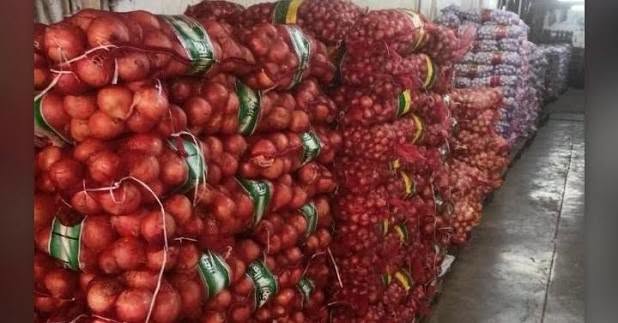

(Photo courtesy of PNA)
MANILA, Philippines – The government has confiscated Php 11.6 billion worth of smuggled agricultural and fisheries products as part of its intensified campaign against agricultural economic sabotage, Executive Secretary Ralph Recto announced Thursday, October 22.
Recto said authorities conducted 67 anti-smuggling operations from February 2025 to July 2026, resulting in the seizure of agricultural contraband and the filing of administrative or criminal complaints against 218 individuals.
He assured the public that the government would continue pursuing cases against those involved until justice is served.
“Smugglers do not only evade duties but food safety checks. We should not let degraded food meant for dumpsters in other countries end up in our own tables,” Recto said.
The executive secretary also warned that the anticipated El Niño dry spell could encourage smugglers to exploit possible agricultural supply shortages.
“Crisis creates opportunities, and when water shortage looms, the smugglers see this as a cue to flood the market with their illicit products,” he said.
Recto emphasized that increasing domestic agricultural production remains the government’s primary strategy for strengthening food security, alongside stricter enforcement against smuggling.
“The President wants escalation on two fronts. The first is to boost production, more so that every year we are adding 1.5 million to our population, and that is the demographic reality. And the second is to curb smuggling because it disincentives local production,” he said.
The government’s campaign is supported by Republic Act 12022, or the Anti-Agricultural Economic Sabotage Act, signed by President Ferdinand Marcos Jr. in September 2024.
The law expands the list of punishable offenses involving agricultural smuggling and imposes heavier fines and longer prison sentences on violators.
Under the measure, a Special Team of Prosecutors was established to handle cases involving agricultural economic sabotage. Recto said the team recently secured the conviction of seven individuals involved in tobacco smuggling.
The law also created the Anti-Agricultural Economic Sabotage Council, a multisectoral body tasked with coordinating government efforts against agricultural smuggling.
To strengthen its operations, the Department of Budget and Management authorized 49 additional positions requiring multidisciplinary expertise for the council’s full-time secretariat.
The secretariat is headed by retired Police Major General Leonora Camarao as executive director.
Recto said the council must function as an active enforcement and coordination body rather than merely hold periodic meetings and review reports.
He also stressed the importance of using modern information technology and intelligence gathering to strengthen border security, particularly along the country’s extensive coastline.
“One particular challenge is how to tap information technologies to plug our porous borders along our long coastline, and render this inhospitable to smugglers,” he said.
Recto added that authorities are shifting toward a continuous, intelligence-driven approach to dismantle networks involved in agricultural smuggling and other forms of economic sabotage.
The government aims to protect local farmers, ensure food safety, and prevent illegal imports from undermining domestic agricultural production.