
By Marita Moaje
MANILA – The Philippines is exploring Norway’s Deposit-Return Scheme (DRS) for single-use plastic bottles and cans, which gives consumers refunds for returning used containers, as the government seeks to strengthen recycling and reduce plastic waste.
At the Norway-Philippines Circular Economy Conference 2026 in Makati City on Thursday, Department of Environment and Natural Resources (DENR) Secretary Juan Miguel Cuna said the agency would help Norwegian companies connect with local government units (LGUs) and other partners to establish pilot sites.
“We’re going to assist them also in terms of helping them collaborate with pilot areas like local government units at iba pang mga (and other) entities,” Cuna said in an interview with the Philippine News Agency.
Meanwhile, Norwegian Ambassador Kristian Netland, in a separate interview, said a pilot project at a Philippine university is expected to begin in the first quarter of 2027, with support from the German development agency GIZ and the European Union.
“We have the technology; we have the systems for this. We are now trying this as a pilot at a university in the Philippines,” Netland said.
Under the scheme, consumers earn a cash or digital reward for returning beverage containers through reverse vending machines or community collection hubs.
The university pilot is considering a process in which buyers present a stub along with the container at a reverse vending machine.
A digital QR-based system is also being considered, with all campus retailers expected to participate.
Netland said plastic waste should be treated as a resource that can provide value to those who collect and return it.
“We need to work on this to ensure that we can get that value and reward people when they bring the plastic bottles back to the stores,” he said.
He also disclosed that Norway is also working with other authorities for a framework on “regulations, (and) binding laws on how to treat plastics.”
He said around 90 percent of plastic and aluminum containers in Norway are recycled through the use of the deposit vending machines, a program being implemented with the help of the grocery owners and manufacturers of bottles and bottled drinks.
“Every kid in Norway would know what to do with a bottle. If you find a bottle in the street, you would bring it to a shop and you would recycle it. There is a value in all these bottles. It’s not a lot, but if you get 10 bottles, it would be enough for an ice cream. And all kids would know this,” he added.
Mark Siatta, Advisor for Circular Economy on EU-PH Green Economy partnership of Deutsche Gesellschaft für Internationale Zusammenarbeit (GIZ) GmbH, in a separate Interview, said the project is still in development stage, thus, he cannot give specific figures.
“We are still evaluating the eligibility of the potential project partner to receive project funds. Thus, the project can only run if the outcome of this evaluation proves successful,” he said.
Siatta said the project will run for 10 to 11 months, and is aimed to know the “behavioral insights for deposit return system (DRS), namely, what that deposit rate should be; how, in this case, participants, students, staff, administrators, will behave when a deposit is placed on beverage containers, specifically polyethylene terephthalate (PET) bottles and aluminum cans; (and) the logistics and economics of the circularity on the back end.”
He noted that in Germany, an estimated “50 million bottles and containers are collected daily” while it is around five million bottles per day for Norway.
Asked why the push for recycling for the same use for containers instead of using it for other purposes such as furniture, Siatta said, “ideally you’d want to keep the material at its highest value point as possible.”
“And in this case, reforming it back into a bottle is actually of more value than down-cycling into furniture,” he added.
DENR Undersecretary Jonas Leones said the government aims to develop a model from 2026 to 2030, which other LGUs could replicate.
He said the system could provide additional income to waste collectors, while other technologies could help deal with plastics that are difficult to recycle.
“We will be putting value to the different plastics. Hindi lang point system na ito, hindi lang bigas. Titignan natin kung paano tayo when they return the plastic, the plastic bottles or tin cans, meron na corresponding value and they can already change it into monetary value, pera na yan (It’s not just rice or a point system. Let’s see how we handle it. When they return the plastic, the plastic bottles, or the tin cans, there will already be a corresponding value that they can convert into money),” Leones said.
“They’re already looking for tin cans para way of life na nila. So maganda kasi ito, deposit return system will not only address plastic problem, hopefully, parang poverty alleviation kasi nakakakuha sila ng payment out of the plastic immediately (So this is good because the deposit return system will not only address the plastic problem. Hopefully, it will also help alleviate poverty because they will receive payment out of the plastic immediately).”
Leones said that hopefully, there would already be a complete module of it by 2026 for replication to other LGUs.
He cited an estimated 163 million sachets generated daily in the Philippines and discussed technology that can convert plastic waste into oil as another possible way to manage discarded plastics.
He also raised the possibility of using mobile or barge-based treatment facilities to serve island communities.
The conference also highlighted the need to build markets for recovered plastics.
A bottle recycler said transporting materials across islands adds costs and that collection and processing capacity must be matched by demand from buyers, and called for incentives to encourage the use of recycled materials.
Cuna said the Philippines already has laws supporting waste management and recycling, including the Ecological Solid Waste Management Act of 2000 or Republic Act 9003, and the Extended Producer Responsibility (EPR) Act of 2022 under Republic Act 11898.
He said the challenge is translating these laws into effective collection, recovery, and recycling systems, and stronger markets for recovered materials.
Conference participants also stressed the need to prevent fraud, establish clear responsibilities, and ensure that waste pickers, junk shop operators, and other informal workers benefit from the system.
During the discussion, panelists said the university pilot could help identify implementation issues before wider adoption, with some expressing hope that a nationwide deposit-return program could be possible by 2030. (with report from Joann Santiago-Villanueva/PNA)
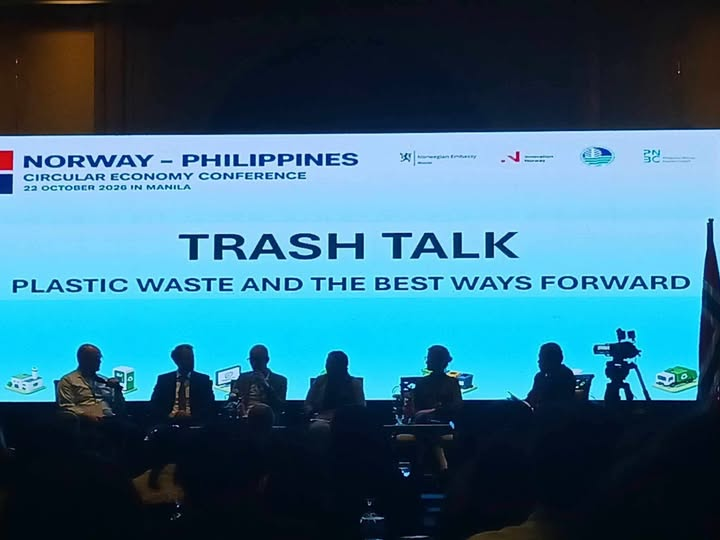
CASH FOR TRASH. Philippine officials explore Norway’s deposit-return system (DRS) for plastic bottles and cans during the Norway-Philippines Circular Economy Conference in Makati City on Thursday (Oct. 22, 2026).