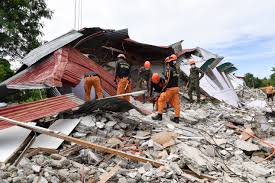

When the magnitude 6.9 earthquake struck Cebu on September 30, it left homes cracked, roads blocked, and hearts shaken. But in the small barangay of Busogon in San Remigio, something remarkable happened—young people whose houses were damaged still found the strength to help others.
Among them was 20-year-old Jane Dablo, who could have easily focused on her own family’s needs. Instead, she and her cousins climbed the coconut trees in their aunt’s backyard, gathered fresh buko, and handed them out to volunteers delivering aid.
Their handwritten cardboard signs read, “Dili ni barter, libre ni!” (This isn’t for barter, it’s free!) and “Help us please! We need food and water!” It was a small but powerful act—sharing what little they had while calling attention to the basic needs of their community.
“Everyone was scared, but helping others gave us something to hold on to,” Jane said. “It reminded us that we weren’t alone.”
In nearby Catmon, Bayan Patroller Zian Bugtai recorded another kind of generosity. Local men stood by the roadside, handing steaming cups of instant noodles to exhausted truck drivers hauling relief goods into quake-stricken towns.
“They didn’t have much, but they knew the drivers had been on the road all day,” Zian shared. “So they cooked noodles, poured them into plastic cups, and served them with smiles.”
Her own family joined in later, traveling across San Remigio, Tabuelan, and Bogo City to distribute food packs and bottled water to displaced families. “We can’t rebuild houses overnight,” she said, “but we can ease the hunger and remind people that someone cares.”
Then there was Ms. Rio, a woman from Lapu-Lapu City whose story warmed hearts online. While bringing relief goods to northern Cebu, she stumbled upon a small home in Barangay Macaas, Catmon—with a sign on its gate that read “Free CR.”
The family who lived there had opened their bathroom to volunteers who had nowhere else to go. Some were also offered hot coffee before returning to their trucks.
“I was touched,” Rio said. “After hours of travel, most gas stations had no restrooms open. But here was a family offering what they had—clean water, warmth, kindness. You could see how grateful people were. You could feel the hope.”
For many Cebuanos, the earthquake was more than a test of infrastructure—it was a test of compassion. From young people climbing coconut trees to strangers opening their doors, it showed that even when walls crumble, humanity stands tall.
As relief operations continue across northern Cebu, stories like these ripple through the province like quiet aftershocks of kindness—reminding everyone that in times of ruin, the truest form of rebuilding begins in the heart.