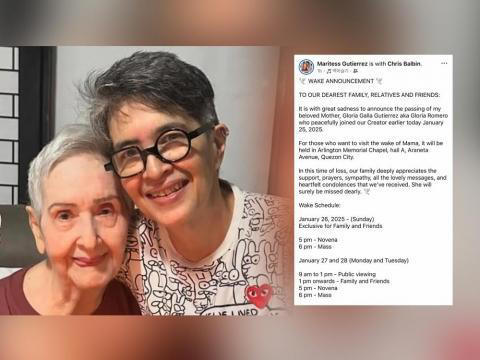

For Maritess Gutierrez, grief has taken on an unexpected and deeply unsettling digital afterlife.
As the family of the late screen legend Gloria Romero prepares to mark her first death anniversary later this month, Gutierrez found herself confronting a cruel twist: a fabricated online article dragging her mother’s name into an alleged multi-billion-peso investment scam.
The fake report, which circulated widely on social media, falsely claimed that Gutierrez was set to receive billions of pesos from a supposed investment platform allegedly linked to her mother’s estate. Posing as a legitimate article from ABS-CBN News, the story carried all the trappings of real journalism—logos, layouts, and language designed to deceive.
Gutierrez first learned about it through a friend who sent her the link early one Sunday morning. A quick glance was enough to leave her shaken and angry.
She described the experience as both irritating and disturbing, questioning why scammers continue to weaponize her mother’s name long after her passing. What stung most, she said, was seeing Romero’s legacy reduced to clickbait bait for financial fraud.
The article went so far as to claim she would receive ₱7.2 billion from the fictitious platform—an assertion Gutierrez categorically denied. Worse, she revealed, this was not an isolated incident. Even before Romero’s wake, similar fake stories had already circulated online, falsely branding her as a billionaire or even a trillionaire.
Beyond the annoyance, the hoaxes have triggered real fear.
Gutierrez admitted that the misinformation has raised serious safety concerns for her family, especially her son, who sometimes commutes via public transport. While she tries to brush it off publicly with laughter, she acknowledged that the situation weighs heavily behind the scenes.
The timing, she said, made it even more painful. With her mother’s death anniversary approaching on January 25, the resurfacing of fake reports felt like an intrusion on a period meant for quiet remembrance. She added that she believes her mother would not want her family burdened by stress and anxiety caused by lies.
Following the spread of the bogus article, ABS-CBN News issued an immediate disinformation advisory, clarifying that the story did not come from any of its official platforms. The fraudulent website has since been flagged and reported.
Government agencies have also renewed calls for caution as online scams grow more sophisticated. The Department of Information and Communications Technology, through the Cybercrime Investigation and Coordinating Center, warned the public against falling for posts that promise impossibly high returns.
Aboy Paraiso, acting executive director of the center, emphasized that exaggerated profit claims—such as guaranteed 60% or 100% returns in just a few months—are immediate red flags. Clicking such links, he warned, can lead to phishing sites that steal personal information or open the door to deeper financial fraud.
Authorities continue to urge users to slow down and verify before clicking. Simple steps—checking website URLs, reviewing “About” pages, spotting spelling errors, avoiding pop-ups, and confirming government registration—can make a critical difference.
For Gutierrez, however, the issue goes beyond cyber safety. It is about protecting a mother’s memory from being distorted and exploited.
As she navigates mourning in the digital age, her message is clear: honoring icons like Gloria Romero should mean preserving their dignity—not turning their names into tools for deception.