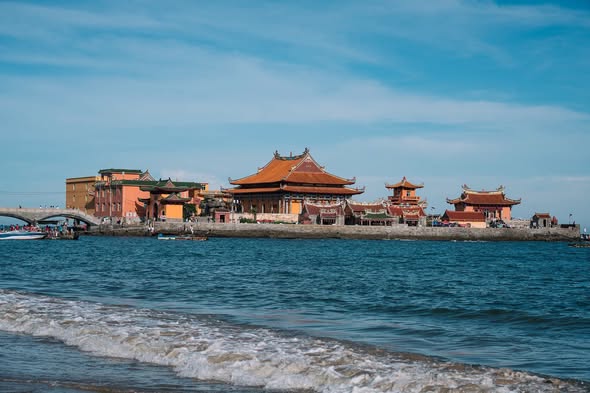

In March 2023, famous Chinese actor Li Xian posted a travel photo during his time at the Luojia Temple in the coastal city of Shishi in the southeastern province of Quanzhou. Hands tucked behind him, the celebrity posed while standing on a bed of rocks jutting out of the ocean off Gongyu Island on a low tide — his all-black ensemble set against the bright orange temple walls and clear blue sky backdrop.
The post went viral and triggered a frenzy of fans and tourists flocking into the monastery to recreate the film star’s shots for their own social media pages.
And who wouldn’t be captivated by this sacred sanctuary? Built in the 1990s on top of an island along the Minnan Golden Coast facing out toward the Taiwan Strait and accessible only through a stone bridge that connects the island to the mainland, the temple seems to be floating in the ocean during high tide, earning the moniker “Buddhist paradise by the sea.”
Talking to a group of visiting journalists from the Philippines’ Integrated State Media, monk leaders at the monastery said the site is dedicated to Guanyin Buddha and features traditional Minnan-style orange walls, golden tiles and swallowtail ridges, giving it that IG-ready look.
They said the temple was built as a much closer alternative for Guanyin Buddha believers in the area, since the nearest monastery of such kind is 10 hours away, tucked in the mountains of Zhejiang Province.
But Luojia is not the only temple in Quanzhou worthy of going viral. The Kaiyuan Temple, built in 686 AD, features everything ancient: a 1,000-year-old Buddhist pagoda made completely of stone and one of the most famous in China; a pillar built in the 1600s and brought to China from India; and a 1,300-year-old mulberry tree struck by lightning in the 19th Century, split into three, and miraculously survived.
And there is also the Southern Shaolin Monastery, birthplace of the Southern Shaolin martial arts in China, founded during the Tang Dynasty becoming part of Minnan culture. The monastery has played an important role in helping the martial arts style spread across the globe, reaching more than 50 countries, including the Philippines.
Shi Licheng, a Kung fu master at the monastery, said their martial artists traveled to the Philippines in 2018 to teach the traditional Chinese martial arts. Proof of its global influence, Southern Shaolin will be among the disciplines which competitors around the world would be competing in next week in Quanzhou (Nov. 12). The Philippine delegation will be sending three Shaolin martial artists to compete.
Tourists leaning toward the performing arts more than the martial arts may opt to see opera or puppet shows, which come in abundance in the city. The Quanzhou Puppet Theater, for instance, features “silk thread puppetry” at its finest, with highly trained puppeteers bringing string puppets or marionettes to life with a mere swish and flick of their fingers.
A rambunctious monkey playing the guitar then later scaling his puppeteer’s leg, an underworld emperor making himself tea, and a young female scholar gliding across the stage with finesse — all these puppets, weighing as heavy as 2 kilograms each, perform intricate movements with delightful precision at their masters’ command.
The puppet masters behind them — who underwent five years of rigorous training — said their company — in existence for more than a thousand years — enthralls as many as 400,000 spectators a year, even performing for a Filipino audience in Iloilo in 2024.
Asked what inspires him to pursue this craft, Wang Hanyao pointed to his “love of performing, enjoying being on stage, and loving the puppets.” Two hours away from Quanzhou, a different form of puppet theater thrives — glove puppetry — seen everywhere from the ancient streets of Zhangzhou to the historic communal dwellings of Nanjing.
Including the puppet stages, these ancient streets blend well-preserved dynastic architecture with modern-day shopping spots that sell alternative medicine, traditional Chinese snacks, ancient stamps that use red cinnabar paste, and Zhangzhou cotton sculptures – an intangible cultural heritage unique to the city.
Two hours away from the ancient city, in Zhangzhou’s mountainous part, lies the UNESCO World Heritage Site of the Nanjing Tulou. These massive earthen buildings several storeys high and built by the Hakka people housed entire clans of up hundreds of families in a village-style often-circular structures with walls and foundations made of rammed-earth, stone, wood and bamboo.
From the inside, the tulous feels cozy, protected from the elements and complete with kitchens and water wells on the ground floor and residences on the upper floors. But viewed from an elevated spot not too far away, the expansive tulous look imposing, almost otherworldly, its saucer-like dark-tiled roofs giving off somewhat a futuristic yet ancient vibe, nestled amid lush mountain greenery.
What began as a quest for a single camera-ready moment ultimately opens the door to a region where centuries of culture continue to breathe.
Beyond the viral appeal of Luojia’s sea-framed orange walls lies a living landscape where ancient trade routes, spiritual havens, and artistic traditions intersect. Fujian does not merely offer backdrops for passing trends—it offers a window into a heritage that has quietly endured for generations. (PNA)