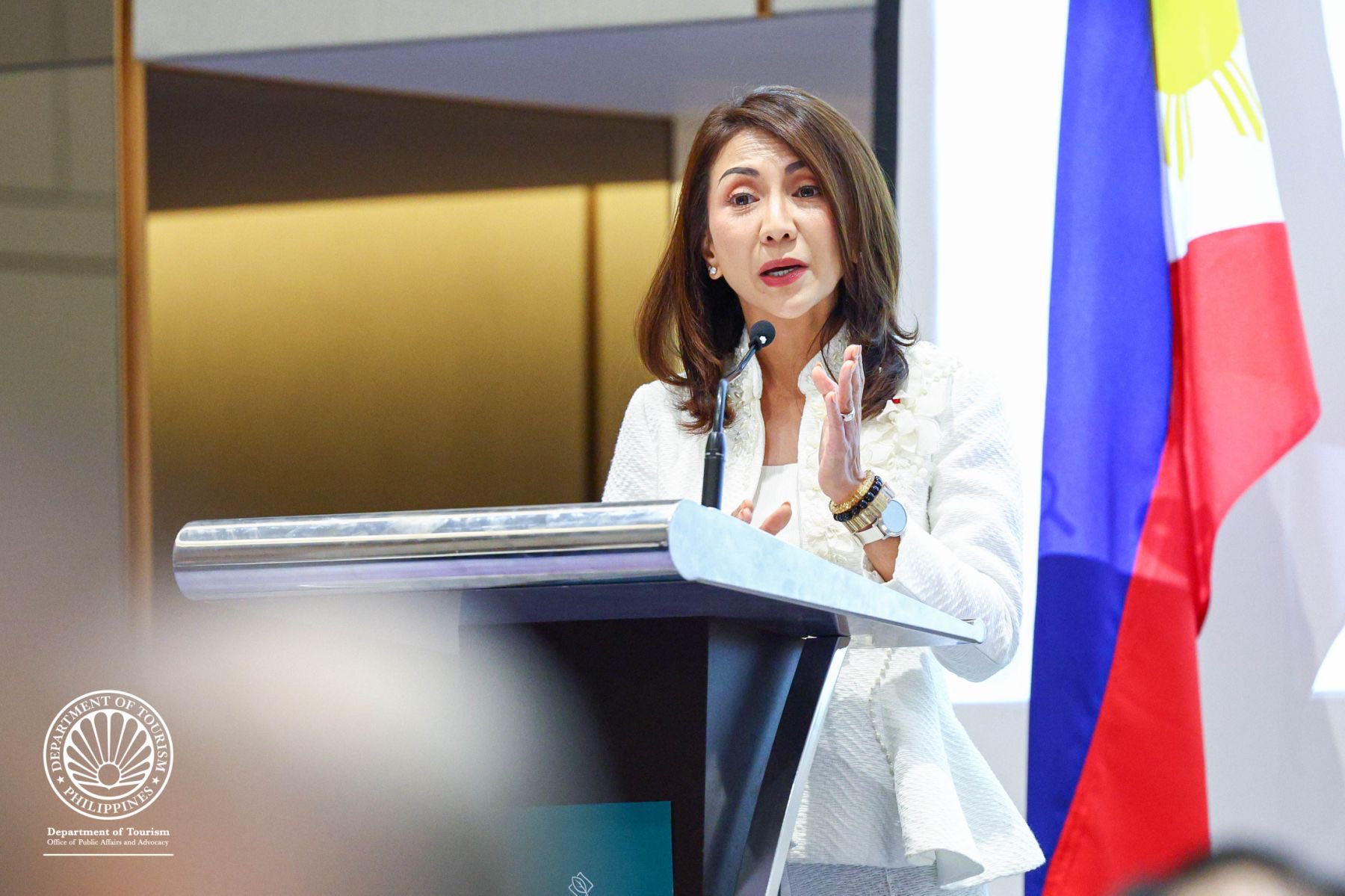

Tourism Secretary Christina Garcia Frasco delivers her keynote address during the Tourism Congress of the Philippines (TCP) 2025 Annual National Meeting, where she renewed the Department’s call for stronger public–private collaboration and invited the industry to help shape the 2026 “people’s tourism budget.”
Tourism Secretary Christina Garcia Frasco opened the country’s 2026 tourism agenda with a renewed push for unity, urging private sector leaders to help shape a more inclusive, industry-driven blueprint for Philippine tourism. The call was made before members of the Tourism Congress of the Philippines (TCP) during their 2025 Annual National Meeting held Tuesday at Lanson Place, Mall of Asia in Pasay City.
Frasco stressed that the Department of Tourism (DOT) is doubling down on its commitment to work hand-in-hand with the industry, reminding stakeholders that the nation’s tourism ambitions can only be achieved through consistent, genuine collaboration.
“I have always reached out my hand of collaboration to all of you,” she told delegates. “We are here under a common aspiration—the desire to elevate Philippine tourism to its rightful place in ASEAN and the world.”
She noted that since 2022, the TCP has served as a “frank, honest, and forward-looking” partner in discussions on competitiveness, economic opportunities, and the fair distribution of tourism gains among workers, businesses, and communities.

Tourism Secretary Christina Garcia Frasco (sixth from left) joins the officers of the Tourism Congress of the Philippines, the government’s consultative body for the development, implementation, and coordination of the country’s tourism policies created under Republic Act (RA) No. 9593, or the Tourism Act of 2009.
A ‘people’s budget’ that puts industry in the driver’s seat
One of the highlights of Frasco’s address was the confirmation that the Senate version of the 2026 national budget restores ₱1 billion for tourism promotions—an important turnaround after two years of cuts.
But this time, she said, the DOT is shifting toward a promotions strategy built around industry priorities rather than bureaucracy-driven plans.
“What will set 2026 apart is that this budget will be driven almost entirely by industry insight,” Frasco said. “We want to hear your priority markets, products, and strategies so government spending results in measurable impact.”
Calling it a true “people’s budget,” she encouraged tourism leaders to submit concrete proposals and be “very vocal and very judicious” in crafting their wish lists for 2026.
Beyond arrivals: A wider lens on tourism success
Frasco also challenged the long-held tendency to judge tourism performance solely by international arrivals, saying the country must embrace a broader, more accurate view of the industry’s impact.
“The Philippines cannot and should not be measured by a singular number alone,” she stressed. “We must look at the full value of tourism to our country.”
Domestic tourism continues to be one of the Philippines’ strongest economic engines. The WTTC projects domestic travel to reach USD 70 billion in 2025—the highest in ASEAN. Meanwhile, the PSA recorded 134 million domestic trips in 2023.
Tourism now employs nearly 7 million Filipinos, with indirect beneficiaries hitting 16 million, and contributes almost 9% to GDP. Receipts in 2024 reached ₱3.86 trillion.
Building the foundations: From infrastructure to innovation
Frasco outlined the DOT’s flagship efforts to strengthen the structural backbone of Philippine tourism. Fourteen Tourist Rest Areas (TRAs) have already been completed nationwide—equipped with clean restrooms, showers, charging stations, PWD-friendly features, and MSME stalls. The target: one hundred completed facilities by the end of the Marcos administration.
Local governments are also pushing tourism development through the Tourism Champions Challenge (TCC), which has awarded ₱255 million to 15 LGUs so far, with nearly ₱400 million more for Cycle 2 infrastructure proposals.
Human capital and innovation continue to be major priorities. A Joint Administrative Order with CHED now channels travel taxes toward scholarships for tourism students in public institutions. The Tourism Startup Challenge supports student-driven solutions in digital tourism, sustainability, and destination development.
Meanwhile, visitor support systems have expanded to include multilingual call center services and enhanced safety personnel training, with over 8,000 tourist police, auxiliaries, and barangay tanods receiving specialized instruction.
Stronger connectivity ahead
Frasco reported ongoing upgrades in air connectivity, including the privatization of NAIA, plus improvements in Bohol, Iloilo, Laguindingan, and other airports. New and upcoming international routes will soon connect the Philippines to San Francisco, Paris, Delhi, Brisbane, and Ho Chi Minh City.
In 2026, the country will also take the global stage as host of the ASEAN Tourism Forum and the UN Tourism Global Gastronomy Forum—fresh opportunities to showcase the Philippines’ growing tourism stature, especially after the arrival of the Michelin Guide.
The TCP Annual National Meeting gathered leaders from accommodation, travel and tours, transport, MICE, estate development, academe, and government sectors—an assembly Frasco hopes will continue shaping the country’s next tourism milestones.