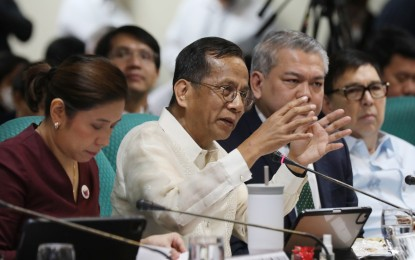

Department of Economy, Planning, and Development Secretary Arsenio Balisacan (center) during a Senate briefing on Sept. 2, 2025. DEPDev on Friday (Jan. 9, 2026) announced that the Economy and Development Council, chaired by President Ferdinand R. Marcos Jr., has approved several infrastructure projects that Balisacan said aim to sustain growth and help achieve the government’s development targets. (PNA file photo by Avito Dalan)
The Economy and Development Council (ED Council) has approved a ₱105.7-billion allocation for the third phase of the Public-Private Partnership for School Infrastructure Project (PSIP III), a move the government says will fast-track classroom construction and strengthen investments in human capital.
In a statement Friday, the Department of Economy, Planning, and Development (DEPDev) said the approval was granted during the council’s latest meeting chaired by Ferdinand R. Marcos Jr..
Under PSIP III, which will be implemented by the Department of Education, around 16,459 new classrooms will be built in 1,095 existing public schools across Luzon between March 2027 and March 2028. The project is expected to benefit at least 800,000 learners annually.
DEPDev said the project will use a solicited PPP modality and a Build-Lease-and-Transfer arrangement, designed to address long-standing delays associated with traditional government procurement. PSIP III will also complement DepEd’s plan to construct roughly 25,000 classrooms funded under the current national budget.
“Addressing critical infrastructure gaps in education is central to sustaining growth and achieving our development targets,” said DEPDev Secretary and ED Council Vice-Chair Arsenio Balisacan. “By investing in classrooms that strengthen learning outcomes, we are laying the foundation for higher productivity, stronger human capital, and inclusive growth.”
Beyond education, the ED Council also cleared a ₱145.56-billion official development assistance project for the Central Mindanao High Standard Highway Construction Project, covering the Cagayan de Oro–Malaybalay section under the Department of Public Works and Highways.
The project involves the construction of a 64.7-kilometer, four-lane highway passing through Tagoloan and Cagayan de Oro in Misamis Oriental and Manolo Fortich, Sumilao, Impasugong, and Malaybalay in Bukidnon. It includes 47 bridges—nine of them long-span structures—and is expected to slash travel time between Cagayan de Oro and Bukidnon from about 6.5 hours to 3.5 hours.
“Improving connectivity between CDO and Bukidnon is a welcome development as we continuously revitalize Mindanao’s regional economy,” Balisacan said. He added that the project is expected to generate jobs, stimulate local businesses, attract new investments, and help reduce poverty by improving mobility and market access.
The council likewise approved the ₱28.24-billion Pang-Agraryong Tulay para sa Bagong Bayanihan ng mga Magsasaka (PBBM) Bridges Project, which aims to improve rural connectivity and market access for agrarian reform communities.
The initiative targets higher productivity and incomes for at least 350,000 households through the construction of durable, permanent modular steel bridges linking farming areas to growth centers and key value-chain nodes.
In addition, the ED Council approved adjustments to the implementation timeline of the Farm-to-Market Bridges Development Program, moving it from fiscal years 2025–2028 to 2026–2029. The ₱27.69-billion program seeks to build 300 modular steel panel bridges across 15 regions to benefit farmers, fisherfolk, and rural communities.
“These projects go beyond engineering solutions,” Balisacan said. “They are strategic interventions to transform subsistence farming and fishing into competitive, profitable enterprises and to stimulate inclusive economic growth across the countryside.”