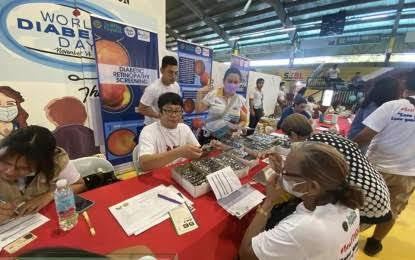

Based on records, one in every 5 Filipinos are diabetic or ore-diabetic. (Photo from the Philippine News Agency)
As a significant health concern with a growing number of diagnosed and undiagnosed cases nationwide, health experts are now saying that early detection of diabetes is a must as the disease has caused more death than hypertensive ailments, such as high blood pressure, and tuberculosis.
On record, deaths due to diabetes ranks fifth in the Philippines with a notable increase in mortality rates in recent years. In 2021, an estimated 4.3 million Filipinos had been diagnosed with diabetes while an additional 2.8 million remained undiagnosed. This translates to roughly 1 out of 14 adults having been diagnosed with diabetes.
So, health experts have made an urgent call for early detection and improved management of type 2 diabetes (T2D) and its leading complication, chronic kidney disease (CKD), which affects an estimated 4.7 million Filipinos.
Accordingly, University of Santo Tomas endocrinologist Dr. Bien Matawaran described the diagnosis and treatment of diabetes as a “silent battle” where the importance of cross-sector collaboration, enhanced support systems and improved public understanding of the disease and its long-term implications as all-important factors in treating the disease.
“Around 40 percent of T2D patients are expected to develop kidney disease in their lifetime, a burden that threatens both individual lives and the country’s health care system,” Matawaran pointed out.
He added that financial constraints also continue to be the biggest barrier to reducing the prevalence of diabetes.
To these revelations, kidney-stroke warrior Cynthia Clemen Duntz, who currently heads the Diabetes Advocacy Society, asserted that the biggest challenge is the combination of “financial toxicity” and a lack of practical education.
“Patients are often overwhelmed. They don’t know how to navigate the system. It’s a journey, and they often feel they are walking it alone,” Duntz cited.
