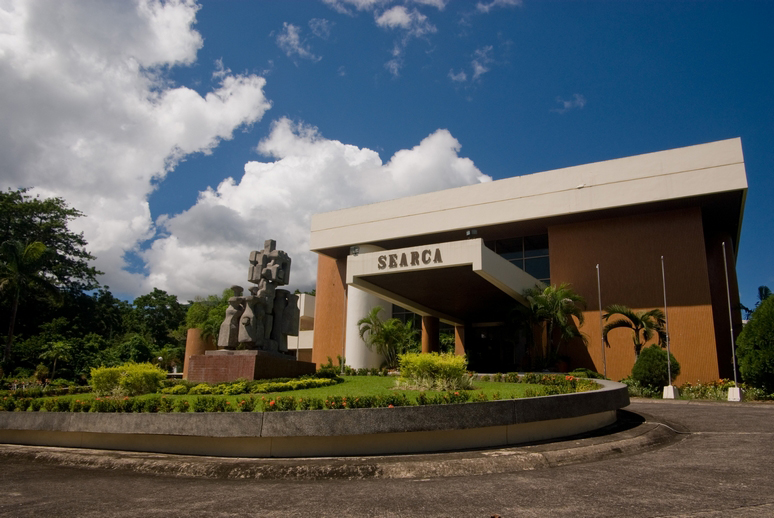

(Photo courtesy of PIA)
LOS BAÑOS, Laguna — The Southeast Asian Regional Center for Graduate Study and Research in Agriculture (SEARCA) has reaffirmed its commitment to advancing agricultural education, research, and innovation as it marks 60 years of supporting agricultural and rural development across Southeast Asia.
SEARCA Center Director Mercedita Sombilla emphasized the need to develop capable leaders and science-based solutions to address growing challenges affecting agriculture, food security, and rural communities in the region.
Speaking during the Outstanding SEARCA Scholarship Alumni Awards 2026 on October 20, Sombilla said Southeast Asia needs leaders who can translate scientific knowledge into practical solutions amid increasingly complex agricultural and environmental challenges.
“Technical expertise alone is not enough to navigate this rapidly evolving landscape of increasingly complex and interconnected challenges facing Southeast Asia. Our region needs leaders with strategic agility to bridge science and society, lead through complexity and uncertainty, build partnerships across sectors, and transform knowledge into solutions that improve lives at scale,” she said.
SEARCA identified climate change, declining agricultural productivity, threats to rural livelihoods, and increasing pressure on natural resources as major challenges requiring stronger regional cooperation and sustainable agricultural practices.
Sombilla stressed that addressing these concerns requires leadership that combines scientific expertise, strategic planning, and collaboration among government agencies, academic institutions, research organizations, and farming communities.
Established in 1966 under the Southeast Asian Ministers of Education Organization (SEAMEO), SEARCA has supported agricultural and rural development through graduate scholarships, research grants, fellowships, policy discussions, and partnerships with academic and development institutions.
The center continues to promote evidence-based policymaking and regional cooperation to improve agricultural productivity and strengthen rural economies.
Under its 12th Five-Year Development Plan covering fiscal years 2025/2026 to 2029/2030, SEARCA is implementing the Sustainable Transformation of Agricultural Systems through Innovation in Southeast Asia (SUSTAIN Southeast Asia) agenda.
The framework focuses on four major outcomes: increasing farmers’ incomes, improving food security and nutrition, strengthening climate-resilient agricultural systems, and empowering farmers, stakeholders, and institutions.
These priorities are organized around four areas: inclusive agrifood value chains and rural development, food and nutrition security, climate-resilient and sustainable farming systems, and education, capacity building, and youth engagement.
SEARCA also aims to strengthen the connection between academic research and practical agricultural applications to ensure that scientific discoveries contribute directly to improved farming practices and rural livelihoods.
Sombilla underscored the importance of partnerships in transforming education and research into meaningful development outcomes.
“Partnering communities, research institutions, government agencies, or development organizations, meaningful progress is achieved when knowledge is coupled with purpose and action. All these are concrete evidence of the transformative power of education to produce committed individuals who regard the importance of service to create impact to develop communities, institutions, and nations,” she said.
As it enters its seventh decade, SEARCA aims to expand its contributions to sustainable agriculture by supporting innovation, strengthening institutional capacities, and preparing future agricultural leaders to respond to emerging regional challenges.
The center maintains that stronger cooperation among researchers, policymakers, farmers, and development partners will be essential to building more productive, resilient, and inclusive agricultural systems across Southeast Asia.