
By Connie Calipay
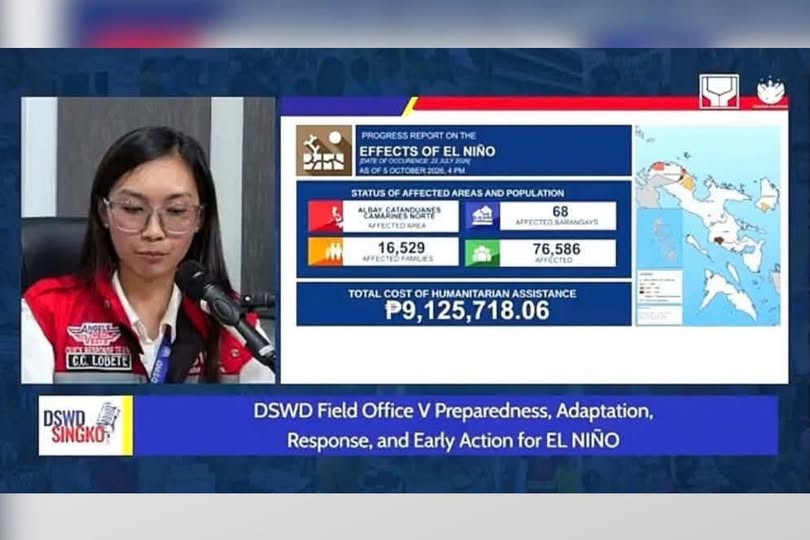
LEGAZPI CITY – The Department of Social Welfare and Development (DSWD) in Bicol on Thursday has so far provided PHP9.12 million in humanitarian assistance to 16,529 families, or 76,586 individuals, affected by El Niño in 68 barangays across Albay, Catanduanes, and Camarines Norte.
In a livestream report, Claire Christine Lobete, head of DSWD 5’s Disaster Response Management Information Section, said the agency has monitored El Niño’s effects since June, using population, damage and risk data to identify vulnerable areas and determine where to deploy assistance and resources.
The data also guide the agency’s preparedness and response planning as it monitors areas that may be affected by the weather phenomenon.
“Based on the Department of Agriculture (DA) Region 5’s Registry System for Basic Sectors in Agriculture (RSBSA), about 960,996 individuals in Bicol are potentially vulnerable to the effects of El Niño. The figure comprises 475,503 farmers, 205,843 agricultural workers, and 279,650 fisherfolk,” she said.
Lobete said that as part of its preparedness measures, DSWD-5 has prepositioned 308,308 family food packs (FFPs) across 58 warehouses in the region.
“As of now, we have already provided more than PHP9 million in humanitarian assistance, which includes family food packs as an intervention for affected families,” she said.
The warehouses have a combined capacity of 502,400 FFPs, 61 percent of which is currently utilized.
The agency also has 15,100 ready-to-eat food boxes and 8,121 bottles of water. Its non-food stocks include 2,786 family kits, 1,089 sleeping kits, 11,263 hygiene kits, 1,503 kitchen kits, 1,000 family water filtration kits, 208 family tents, 11,365 modular tents, and 68 laminated sacks or rolls.
Lobete said that aside from FFPs, DSWD-5 has two mobile kitchens, one mobile command center, and one mobile water system that can be deployed to affected areas when needed.
The agency’s preparedness planning addresses five critical areas related to El Niño: water, food, energy, health, and public security.
DSWD-5 is monitoring water availability, the potential effects of prolonged heat and reduced rainfall on food and crops, increased energy demand, health risks, and forest fires.
“The Assistance to Individuals in Crisis (AICS) also provides financial assistance to affected families,” she added.
Moreover, DSWD-5 is implementing Project LAWA (Local Adaptation to Water Access) at BINHI (Breakthrough Initiatives for Nutrition on Harvest Incomes) to support water access and food production.
The project also provides cash-for-training and cash-for-work assistance to participating communities.
As of Sept. 30, Project LAWA at BINHI had reached about 9,000 beneficiaries and disbursed PHP78.3 million. It had also established 198 LAWA sites and 185 BINHI sites.
DSWD-5 is coordinating with the DA, Bureau of Fisheries and Aquatic Resources, Department of Environment and Natural Resources, and local government units in its preparedness and response efforts.