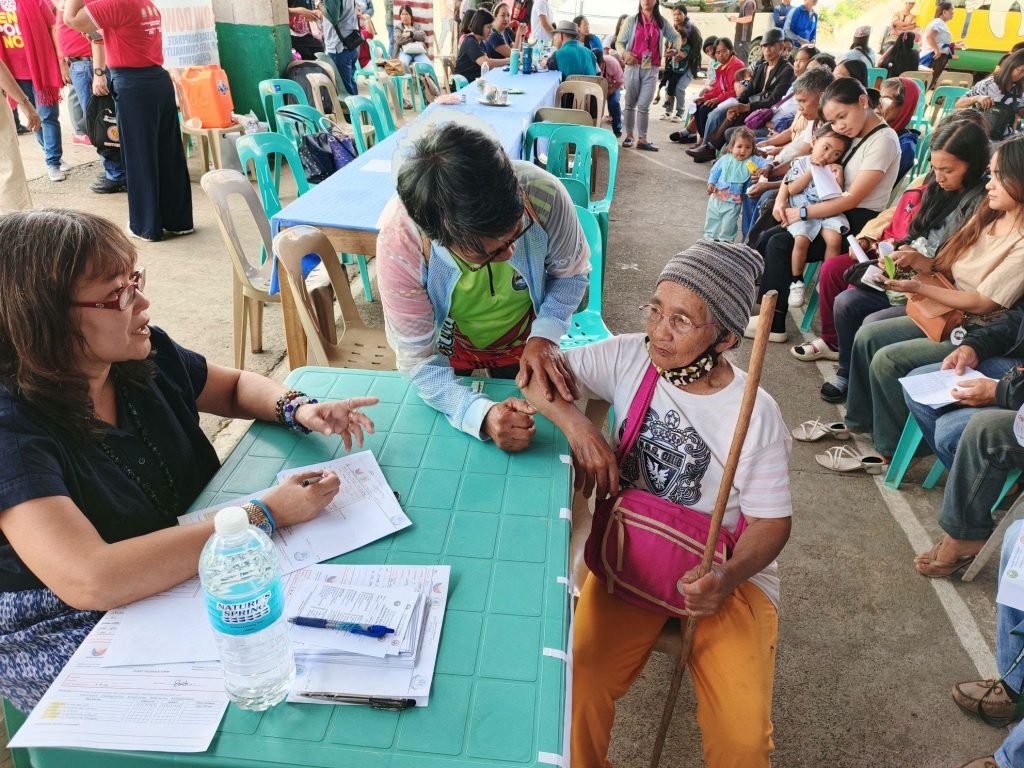
HEALTH CARE INITIATIVE. Health officials from the World Health Organization and the Department of Health, together with the barangay health workers and local government officials of Tabaco City, Albay, join the launch of “Proteksyon Para sa Altapresyon” at Tabaco City, Albay on Thursday (May 28, 2026). The initiative also aims to achieve a 50-percent hypertension control rate by 2028 through strengthened primary care and community engagement. (PNA photos by Connie Calipay)
LEGAZPI CITY – The Department of Health in Bicol (DOH-5) has enhanced its efforts to deliver improved healthcare for Bicolanos, especially those with hypertension, by launching the DOH’s Proteksyon Para sa Altapresyon program in Tabaco City on Thursday.
In a message from DOH-5 Director Rosa Maria Rempillo, conveyed by officer-in-charge Assistant Regional Director Rey Millena, the initiative aligns with President Ferdinand Marcos Jr.’s directive to enhance preventive healthcare and address the rising challenge of non-communicable diseases.
Hypertension, a major risk factor for heart disease, stroke and early death in the Philippines, remains a primary focus.
“In the Bicol Region, data from the May Measure Month 2025 campaign showed that more than 1.5 million individuals were screened, with 189,153, or 17 percent, found to have elevated blood pressure. However, an estimated two million adults remain unscreened,” Rempillo said.
Rempillo said the Proteksyon Para sa Altapresyon rollout aims to shift the health system’s focus from treatment to prevention by bringing essential services directly to communities and encouraging early screening, continuous monitoring, and sustained disease management through the DOH PuroKalusugan (PK) grassroots program.
“The initiative also aims to achieve a 50 percent hypertension control rate by 2028 through strengthened primary care and community engagement,” she said.
Rempillo also thanked partners and local implementers who continuously promote health programs and ensure that every Bicolano gets access to the highest quality of health care.
“We are very fortunate that we have dedicated teams of health care workers on the ground to conduct activities like the Philippine Package of Essential Non-Communicable Disease Interventions (PhilPEN) and PK,” she added.
By strengthening collaboration among health facilities, local governments, workplaces, communities, and partner institutions, the initiative aims to expand access to care, improve treatment adherence, and build healthier, resilient communities across the Bicol Region.
Dr. Yu Lee Park, the World Health Organization (WHO) health systems strengthening team lead for the Philippines, said the program aims to deliver a whole-of-government approach and a whole-of-system care for people living with hypertension.
“The initiative will provide strong technical guidance to the DOH, from the physician in the city health office to the barangay health worker. It will build the capacity of every health worker to have the skills and confidence to detect, counsel, and manage hypertension,” she said during the program launch.
Park added the program will ensure proper forecasting of antihypertensive medicines to match the needs of each community so that no one enrolled in the program is turned away for lack of medicine.
Furthermore, Park urged local government units in the region to integrate the program into their institutional systems, not merely as a campaign, to ensure ongoing healthcare services for the public.
Dr. Raymond Martin Corpus, medical officer IV of DOH-5, said that as part of their augmentation to the region, at least PHP49 million worth of medicines and PHP12 million for equipment for hypertension and diabetes will be distributed to different geographically isolated and disadvantaged areas.
“We are expecting that this second semester, we can distribute all the medicines to the different provincial health offices,” he said. (PNA)