
MANILA – The Department of Budget and Management (DBM) encouraged Filipinos to actively monitor government expenditures through its unified budget transparency platform to promote public accountability and responsible management of government resources.
During the 20th episode of A.S.K. – Alamin kay Sec. Kim on Friday, Budget Secretary Kim Robert De Leon stressed that every Filipino has the right to know how public funds are allocated, released, and spent.
“Ang pera ng bayan, hindi dapat misteryo sa taumbayan,” De Leon said.
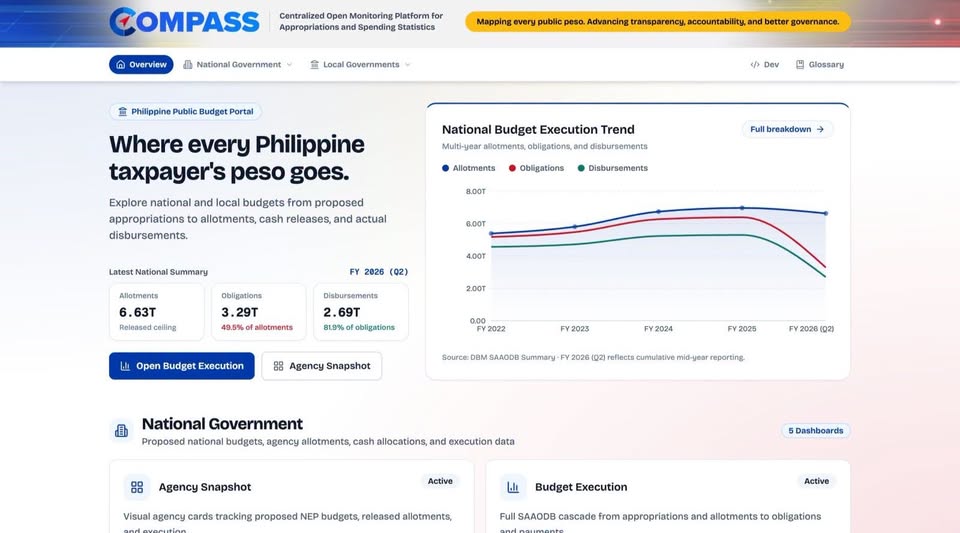
He encouraged citizens to utilize the Centralized Open Monitoring Platform for Appropriations and Spending Statistics (COMPASS), which consolidates government financial information, including budget allocations, expenditures, procurement activities, and projects.
Accessible through https://compass.gov.ph/, the platform was launched on June 26 and institutionalized through Executive Order (EO) 126 issued in September.
Under the executive order, national government agencies and instrumentalities, including government-owned or controlled corporations (GOCCs) and government financial institutions, are required to submit, disclose, and regularly update relevant financial information.
Local government units (LGUs) are also encouraged to participate in the transparency initiative.
Understanding government spending
De Leon explained the four stages of budget execution to help citizens better understand how government resources are utilized.
These include appropriation, which provides legal spending authority; allotment, which authorizes agencies to incur obligations; obligation, which represents a financial commitment; and disbursement, which refers to the actual payment of government obligations.
“Hindi porke may budget na, ibig sabihin nagastos na. At hindi porke may inilabas nang pondo, ibig sabihin naibayad na ito. Magkaiba ’yun,” De Leon said.
Through COMPASS, citizens can monitor the status of government funds at various stages of budget execution based on available official records.
The platform also enables government employees to track fund releases for their respective agencies, including allocations for the Performance-Based Bonus (PBB).
De Leon clarified that a Special Allotment Release Order (SARO) authorizes government agencies to incur obligations for specific purposes, while a Notice of Cash Allocation (NCA) allows agencies to access funds through authorized government servicing banks to settle their financial obligations.
“Ang SARO ay hindi automatic na cash. At ang NCA ay hindi rin automatic na patunay na natanggap na ng empleyado ang kanyang bonus,” he explained.
Strengthening public accountability
COMPASS also provides citizens with access to available funding information for their provinces, cities, municipalities, and barangays, including SARO and NCA records related to the National Tax Allotment (NTA) and Local Government Support Fund (LGSF).
The DBM is working with other government agencies, including the Department of Information and Communications Technology (DICT), to expand the platform’s coverage and introduce additional features.
While information on some government projects remains unavailable on COMPASS, the department said its continued development aims to make public financial records more accessible, encourage citizen participation in monitoring government expenditures, and strengthen transparency and accountability in the use of taxpayers’ money.