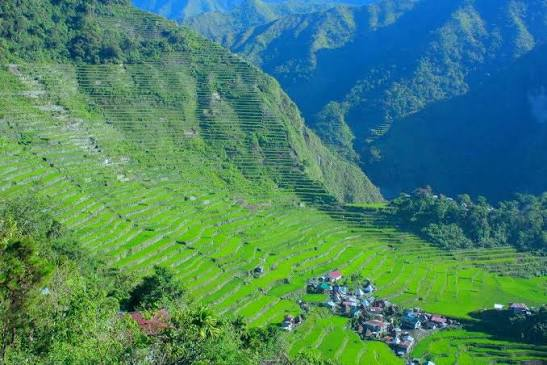

Banaue rice terraces. Photo courtesy of PNA.
Currently facing infrastructure deterioration, lack of ample irrigation and the gradual shift of farmers to more profitable vegetable farming, the Department of Agriculture (DA) has decided to step up its efforts in restoring the country’s fable rice terraces in Banaue.
Agriculture secretary Francisco Tiu Laurel Jr. visited the United Nations Educational, Scientific and Cultural Organization (UNESCO) World Heritage site over the weekend to assess the terraces’ condition and consult local farmers and officials on improving productivity, climate resilience and rural livelihoods.
On assessment, Secretary Tiu Laurel cited that the terraces are suffering from deteriorating stone walls, degraded irrigation networks and worn-out tram lines even as huge earthworms had repeatedly damaged its structural integrity in the past.
The problem is also compounded from resolution by UNESCO preservation rules that complicate the issue by restricting the use of non-traditional materials in its restoration.
Local stakeholders have sought support for structural and irrigation rehabilitation and restoration, disaster mitigation and heirloom rice conservation but to no avail.
For 2027, the DA has proposed a P147-million terrace restoration in the Cordillera, including P68 million for Ifugao and P30 million for two agricultural tram lines. This year, the agency has allocated over P218.8 million for Ifugao covering rice, corn, high-value crops, livestock and climate adaptation programs to benefit more than 400 farmers’ organizations.
The DA’s Philippine Rural Development Project has also been implemented in Ifugao, funding 10 major infrastructure projects worth over P2.025 billion, including seven farm-to-market roads, two potable water supply systems and one communal irrigation system, on top of 18 completed projects worth P810.55 million.
“The Ifugao Rice Terraces are more than a cultural treasure. They are a living agricultural system that supports food production, tourism, and rural livelihoods,” Tiu Laurel pointed out.
“Our heirloom rice presents a significant opportunity for export, and we are determined to position it as a premium Philippine product recognized worldwide,” he added.