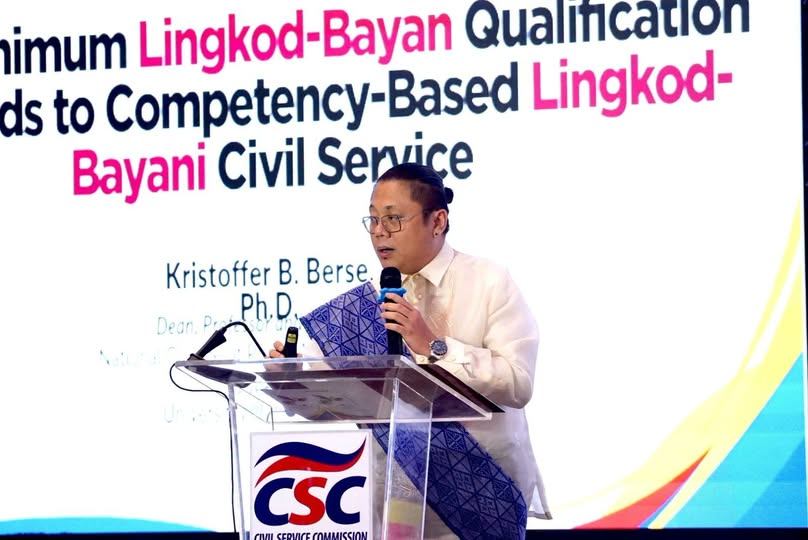

MANILA – The government must assess public servants’ actual competencies alongside their credentials to address job mismatch, fill vacancies and improve service delivery, University of the Philippines National College of Public Administration and Governance (UP NCPAG) Dean Kristoffer Berse said Thursday.
In his speech at the Civil Service Commission’s (CSC) BANYUHAY: National Public Service Summit, Berse pushed for a competency-based human resource management system that aligns recruitment, training, promotion and performance evaluation with actual job requirements.
“This underscores the need for us to transition toward a competency-based human resource management framework that raises meritocracy by placing greater emphasis on demonstrated competencies, actual job requirements, and continuous professional development alongside the appropriate educational qualifications, training, and experience,” he said.
He cited consultations conducted by the CSC and UP NCPAG that found job mismatches, including nurses working in administrative positions, accounting graduates assigned to human resources and medical technicians working in agricultural research.
“Their skills are important but not fully maximized with the positions that they occupy. That’s a problem,” he said.
He said the revised Qualification Standards (QS) Manual, which dates back to 1997, needs updating to reflect changes in government work, including demand for expertise in data analytics, artificial intelligence and strategic foresight.
“In other words, the old QS does not reflect the work realities of the present, and certainly they need to be revisited to anticipate future needs,” he said.
Berse also cited limited career pathways and insufficient compensation for positions requiring specialized qualifications as obstacles to attracting and retaining skilled personnel.
As of June 30, 2026, he said government had 224,999 vacant plantilla positions, including 95,505 in national government agencies and 87,762 in local government units.
“The need to shift from QS to competency-based HRM is inevitable because the nature of public service and the work that is demanded of public servants are also fast evolving,” he said.
Digitalization requires both new skills and a change in how government employees approach their work, while rising public expectations demand faster, more transparent and accountable services.
“Accountability is now measured by tangible results. It’s no longer enough to say, ‘Sumunod kami sa tamang proseso (We followed the proper process).’ The real question now is, ‘Did the program actually make lives better?’” he said.
“We are moving from simply following steps to delivering actual measurable outcomes for the public,” he added.
The CSC and UP NCPAG are undertaking the Development of New Qualification Standards project to review existing standards, identify emerging competency requirements and develop a system for their periodic updating.
At the agency level, he urged offices to define essential competencies, align these with specific duties and use observable, measurable indicators in evaluating employees.
“For instance, core competencies such as citizen-centeredness, excellence, and integrity are non-negotiable standards required across all positions, from administrative aides to executive directors,” he said.
Assessment methods must also match the skills being evaluated because “not all competencies can or should be measured on a written exam.”
Berse noted that behavioral interviews, feedback and supervisor observations as options for assessing leadership.
Reforms must extend beyond hiring to employee development, recognition, succession planning and performance management, supported by stronger collaboration between government and schools preparing future public servants.
“Our future-ready bureaucracy cannot be built through fragmented reforms. Across different agencies, we must work together,” he said.
The two-day summit brings together government leaders, policymakers and experts to discuss civil service transformation through Filipino values, meritocracy, institutional reform and digital innovation. (Ma. Teresa Montemayor/PNA)