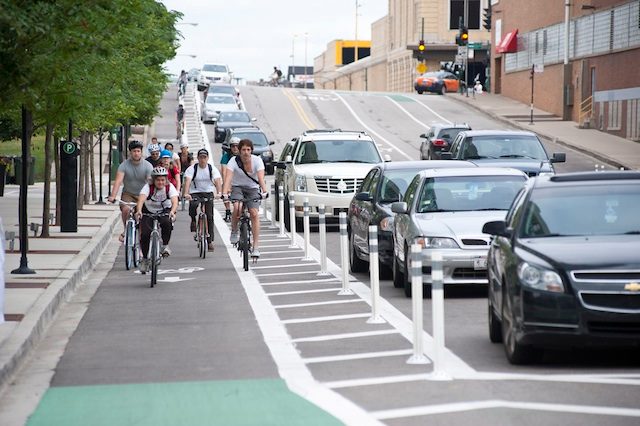

Citing that government should switch up its infrastructure mindset to prioritize as well the completion of active transport facilities, the Move As One Coalition is asking the Department of Transportation (DoTr) to prioritize completing short-term projects like bike lanes and pedestrian walkways to ease travel among millions of commuters across the country, particularly in cities and other highly urbanized centers of population.
In support of this endeavor, the advocacy group composed of some 150 non-government organizations (NGOs) and individuals is pushing for a hike in the active transport budget to as much as ₱3 billion as Filipinos are now more open to cycling and walking to their destinations.
According Move As One Coalition co-convenor Robert Siy, the DoTr is too focused on building large-scale railways, particularly the ₱873.6-billion North-South Commuter Railway (NSCR) and the ₱488.5-billion Metro Manila Subway Project (MMSP) and although these projects would bring the most benefits, they would still require at least a decade to be built.
On record, the NSCR, the country’s single largest infrastructure investment to date, its partial operations are scheduled by 2027 for the Malolos-Valenzuela section and by 2028 for the Malolos-Clark line even as complete operations are projected by 2032.
On the other hand, the ongoing MMSP still has to resolve challenges in obtaining right-of-way concerns in business districts and posh villages, pushing completion to as far as 2032.
“Given this, it is important for the DoTr to make more transit options available now, and this can be achieved if the agency invests in active transport, because for us, active transport infrastructure is what you can deliver faster and it has the most inclusivity, and it has profound impact on the mobility of ordinary Filipinos,” Siy pointed out.
Based on latest budgetary developments, the DOTr was given just ₱69.38 million for active transport projects in the National Expenditure Program (NEP) for next year. However, lawmakers injected an additional ₱250 million to boost funding for bike lanes and pedestrian walkways.
Despite this, Siy believes at least ₱3 billion is needed annually to build up the active transport network in line with the demand, especially since Filipinos are becoming more inclined to bike or walk to school or work to avoid dealing with traffic congestion.
Based on preliminary results from the Active Transport Strategic Master Plan (ATSMP), walking is now the main mode of transport among Filipinos—beating tricycles and other public transportation sych as passenger jeepneys and buses.
“About one third of all trips around our big cities are three kilometers or less, short trips, making them bikeable and walkable,” Siy noted to mention the ATSMP’s assessment that most Filipinos are okay to walk to their destination for as long as it just takes half a kilometer and around 15 minutes.
