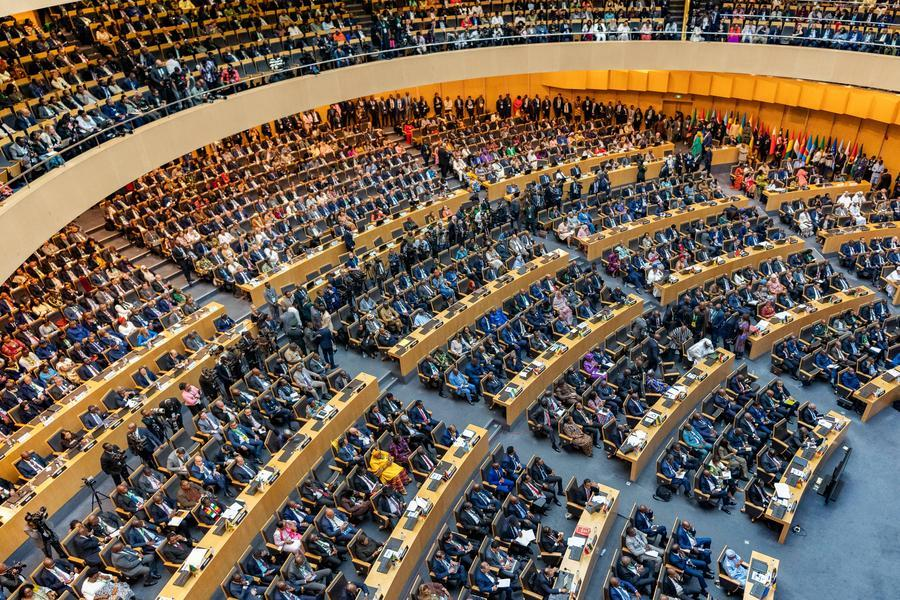

ADDIS ABABA— Chinese President Xi Jinping’s congratulatory message to the 39th African Union (AU) Summit has resonated strongly across the African continent and the wider international community.
In his message, Xi announced that China will fully implement zero-tariff treatment for 53 African countries with diplomatic relations with China starting May 1, 2026. He also highlighted efforts to upgrade the “green channel” for African exports.
African officials, scholars, and United Nations representatives noted that the message demonstrates China’s firm support for Africa’s independent development.
SHARED OPPORTUNITIES FOR MODERNIZATION
Henry Okello Oryem, Uganda’s minister of state for foreign affairs in charge of international cooperation, welcomed Xi’s efforts to increase trade between Africa and China. “The zero-tariff treatment of African products entering China is a good opportunity and a special opportunity for us to increase our exports to China,” he said.
Similarly, Benard Mono, acting director general of the East African Development Bank, said the policy would significantly boost African exports. “It means there will be more manufacturing and more jobs created in Africa,” he said.
Multiple African enterprises targeting the Chinese market noted that the new measures, including the zero-tariff policy, will bring fresh opportunities to expand trade with China and enhance product competitiveness.
Workers sort coffee packages from a machine at the African Coffee Park in Ntungamo District, western Uganda, on Nov. 29, 2025. (Photo by Ronald Ssekandi/Xinhua)
Jackson Mponela, production manager for commerce and development at Tanzania Future Enterprises Company Limited, said the zero-tariff initiative will significantly reduce the cost of Tanzanian products entering the Chinese market. This will “bring us a price advantage and also give us more motivation to expand production scale and improve product quality,” he said.
“China-Africa cooperation is not traditional aid or project-based cooperation, but a partnership that allows African enterprises to truly participate in the modernization process through market, trade, and industrial opportunities,” he added.
Herman Uwizeyimana, general manager of Rwanda’s Fisher Global, said China’s open policies and tangible support are among the biggest drivers of African enterprises’ export growth to China, making Africa-China trade smoother and cooperation more enduring.
Speaking to the media on the sidelines of the 39th AU Summit, UN Secretary-General Antonio Guterres hailed China’s zero-tariff policy for African countries and called on “all developed countries and all countries with large economic potential to take exactly the same measure.”
“Africa needs free trade for its goods, and Africa cannot be penalized—being a continent with enormous economic difficulties—by restrictive trade policies and tariffs that prevent African products from being competitive,” the UN chief said.
Noting the “multiplication of tariffs in recent times,” Guterres reiterated his strong support for free trade and advocated “reducing tariff levels at the global level to promote global prosperity.”
70 YEARS OF A SHARED JOURNEY
The year 2026 marks the 70th anniversary of diplomatic relations between China and African countries, a milestone underscoring a mature, evolving, and deeply rooted partnership.
“The symbolism of President Xi Jinping sending a congratulatory message to the AU Summit signals continued commitment, continued friendship, and the enduring beauty of China-Africa relations,” said Jito Kayumba, special assistant to the president of Zambia on finance and investment, adding that the partnership “is represented in action.”
Michael Ndimancho, a scholar at the University of Douala in Cameroon, said Xi’s message was sincere and moving. “When I read the letter, I sensed a sincere and brotherly partner for Africa,” he said.
He noted that China-Africa exchanges and cooperation in poverty reduction, food security, industrialization, and sustainable development have helped Africa play a greater role in global governance.
Over the past 70 years, Africa-China relations have achieved significant progress, said Tabani Moyo, a research fellow at the Graduate School of Business and Leadership at the University of KwaZulu-Natal.
Bilateral cooperation has expanded from traditional areas such as infrastructure and trade to emerging sectors including industrial upgrading, digital innovation, and green energy, Moyo said.
These collaborations have enhanced Africa’s capacity to become “active players in the production and manufacturing of commodities that reach the global stage,” he added.
An aerial photo taken on Dec. 13, 2019 shows the 50-MW solar power farm in Garissa, Kenya. Designed and built by China Jiangxi Corporation for International Economic and Technical Cooperation in conjunction with Kenya’s Rural Energy Authority, the plant is one of the largest photovoltaic power stations in Africa. (Xinhua/Xie Han)
Humphrey Moshi, director of the Center for Chinese Studies at the University of Dar es Salaam in Tanzania, said the TAZARA Railway remains a powerful symbol of friendship to this day.
In recent years, projects such as roads, ports, and power facilities have significantly improved livelihoods and economic conditions across Africa.
Beyond infrastructure, Moshi said cooperation in talent development has also made major strides, “helping Africa build stronger self-driven growth.”
UNITING THE GLOBAL SOUTH
In his message, Xi highlighted accelerating changes in the global landscape and the remarkable rise of the Global South, praising the AU’s leadership in advancing African integration.
In the face of hegemonism, unilateralism, and tariff disruptions, “the Global South, embodied by China-Africa solidarity, is pivotal to multipolarity and equity,” said Raimundo Goncalves, an international relations specialist at the Association for the Study of China in Angola.
Dereck Goto, a Zimbabwean political commentator, noted that 2026 marks the start of China’s 15th Five-Year Plan. “China’s next development phase emphasizes innovation, green growth, technological upgrading, and resilient supply chains. This aligns directly with Africa’s industrial ambitions,” he said.
Exhibitors attend to visitors at their booths during the Africa Tech Summit in Nairobi, Kenya, on Feb. 11, 2026. (Photo by Henry Naminde/Xinhua)
“As China prioritizes higher-quality growth and domestic demand expansion, African economies that strengthen processing and manufacturing capacity will be better positioned to integrate into these emerging sectors,” Goto added.
Looking ahead, Kenyan international relations scholar Adhere Cavince said China and Africa will work together to establish a model of mutually beneficial, win-win modernization and development.
“The partnership should deliver tangible prosperity, respect sovereignty, and contribute to a just and inclusive world order in which the Global South shapes its own destiny,” Cavince said. (Xinhua)