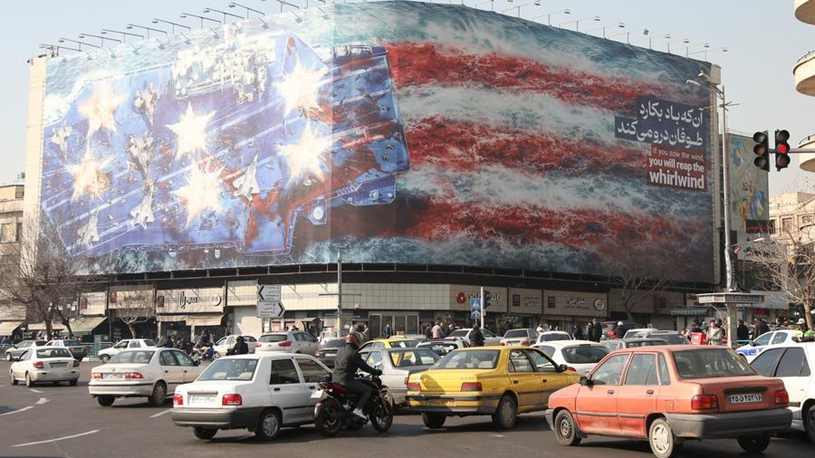

This photo taken on Jan. 27, 2026 shows a giant banner in Tehran, Iran. (Xinhua/Shadati)
As Trump weighs “phase two,” Tehran heads to Geneva for second round of talks with red lines intact
CAIRO — Iranian Foreign Minister Seyed Abbas Araghchi headed to Geneva on Sunday for a second round of indirect talks between Tehran and Washington, even as the parties involved laid out starkly different visions of what a deal should entail, exposing the fragile foundations of the renewed diplomatic push.
Araghchi is leading a “diplomatic and specialized” delegation to the talks scheduled for Tuesday. He is expected to meet Swiss Foreign Minister Ignazio Cassis, Omani Foreign Minister Sayyid Badr bin Hamad Al Busaidi, and Rafael Grossi, director general of the International Atomic Energy Agency, among other officials, according to a statement from Iran’s foreign ministry.
U.S. President Donald Trump’s special envoy, Steve Witkoff, will lead the American delegation, according to media reports.
The Geneva meeting follows the first round of talks held in Muscat, Oman, on Feb. 6, which both sides described as a “good start” but produced no visible breakthrough.
In public statements ahead of the Geneva meeting, Iranian officials struck a tone of conditional openness mixed with defiance. Speaking to the BBC on Sunday, Iran’s Deputy Foreign Minister Majid Takht-Ravanchi signaled Tehran’s willingness to compromise on its nuclear program in exchange for sanctions relief, while drawing firm red lines.
“The ball is in America’s court to prove that they want to do a deal,” Takht-Ravanchi said.
He confirmed that Iran could discuss diluting its 60-percent enriched uranium as a demonstration of flexibility, but categorically ruled out zero enrichment on Iranian soil.
“It is not on the table anymore,” he said, reiterating that Iran’s missile program remains non-negotiable.
Hamid Ghanbari, a deputy foreign minister for economic diplomacy and a member of Iran’s negotiating team, said past discussions in Muscat explored joint investments in energy and mining projects, as well as the potential purchase of U.S.-made aircraft, according to Iran’s semi-official Fars News Agency.
Any agreement, Ghanbari stressed, must ensure the release of Iran’s frozen assets abroad in a “real and usable” manner. He added that while Tehran seeks a “serious agreement,” it will not accept a deal that mandates zero uranium enrichment.
Meanwhile, Iran’s armed forces chief of staff, Abdolrahim Mousavi, warned on Sunday that any war would carry consequences for the United States.
“If Trump seeks war with Iran, why does he speak of negotiation?” Mousavi said, according to Iran’s official IRNA news agency, adding that entering a conflict would “teach him a lesson” and end his “blustering.”
Signals from Washington have also been mixed. U.S. Secretary of State Marco Rubio said Trump prefers diplomacy and a negotiated settlement.
“No one’s ever been able to do a successful deal with Iran, but we’re going to try,” Rubio said at a news conference in Bratislava, Slovakia.
Israeli Prime Minister Benjamin Netanyahu, following his meeting with Trump in Washington, said Trump is “determined to exhaust the possibilities of achieving a deal, which he believes can be achieved now.”
Trump, however, has kept military options on the table. He told reporters on Thursday that if negotiations fail, “we’ll have to go to phase two. Phase two will be very tough for them.”
On Friday, Trump said the USS Gerald R. Ford, the world’s largest aircraft carrier, had been ordered to join the USS Abraham Lincoln and three guided-missile destroyers already deployed to the Middle East.
Tensions appear to run deeper behind the scenes. CBS News reported Sunday that Trump told Netanyahu as early as December that he would support Israeli strikes on Iran’s ballistic missile program if a deal cannot be reached.
The report said U.S. officials have since begun internal discussions on how to assist such an operation, including providing aerial refueling for Israeli aircraft and securing overflight permissions from countries along potential flight paths.
Netanyahu has maintained a maximalist stance. Speaking at a public conference on Sunday, he insisted that any agreement with Iran must include the removal of nuclear material, a halt to uranium enrichment, and restrictions on ballistic missiles.
He reiterated his skepticism about “any deal with Iran.”
With U.S. warships massing in the region and both sides preparing for the possibility of diplomatic failure, the upcoming talks in Geneva are widely seen as a critical test of whether diplomacy can still offer a path forward — or merely serve as a prelude to deeper confrontation. (Xinhua)