
(Photo courtesy of Anadolu)
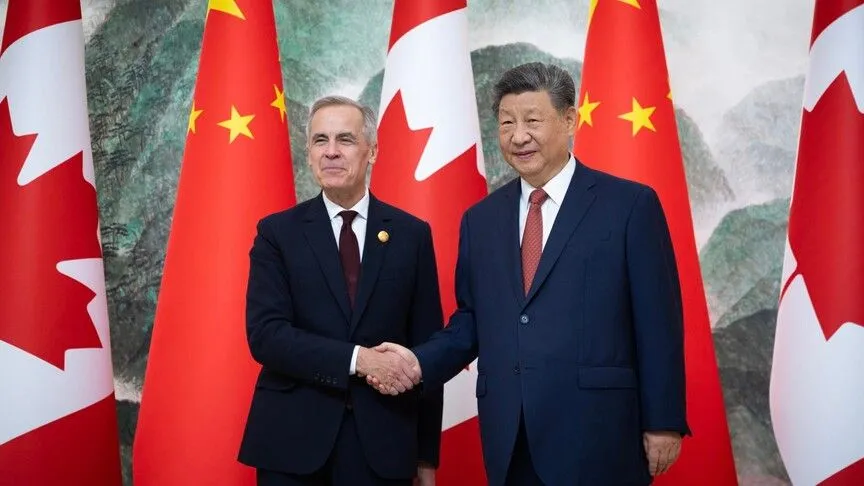
ISTANBUL – Canadian Prime Minister Mark Carney and Chinese President Xi Jinping agreed Tuesday to expand bilateral trade through reciprocal tariff relief and new commercial agreements, despite threats of additional tariffs from the United States.
The agreement was reached during talks in Shenzhen, southern China, ahead of the Asia-Pacific Economic Cooperation (APEC) Economic Leaders’ Meeting.
The two leaders announced measures aimed at improving market access, strengthening business relations and expanding cooperation in education, transportation and environmental protection.
“Canada and China have recalibrated our relationship to the benefit of citizens in both countries,” Carney said in a statement released by his office.
He said the agreements would make it easier for people to travel, study and conduct business between the two countries.
Under the expanded trade arrangement, China will provide tariff relief covering approximately CAD 400 million (USD 279.7 million) worth of Canadian exports.
The measures include CAD 116 million (USD 81 million) in frozen pork products and CAD 285 million (USD 199 million) in fish and seafood exports.
The latest concessions build on nearly CAD 7.5 billion (USD 5.2 billion) in Canadian trade access restored since January.
In return, Canada will extend existing tariff exemptions on selected Chinese steel and aluminum products for another two years beyond their scheduled expiration in late 2026.
Ottawa will also add 32 steel and aluminum tariff items to the relief measures, particularly for products where domestic Canadian supply remains insufficient.
Expanded cooperation beyond trade
Carney also announced CAD 8.85 million (USD 6.19 million) in combined funding to support environmental cooperation and scholarships for students pursuing studies in China.
Both countries agreed to designate 2027 as the Canada-China Year of E-commerce to encourage greater digital trade and business cooperation.
Canada also plans to organize a trade mission to China in 2027 as part of efforts to expand commercial opportunities.
In the aviation sector, Air Canada will introduce new flights between Vancouver and Guangzhou beginning in May 2027, while Chinese airlines are expected to increase their services to Canada.
The two governments also welcomed more than CAD 15 million (USD 10.5 million) in arts and cultural agreements.
Other initiatives include the establishment of a new chief executive roundtable to promote business engagement and a university dual-degree program aimed at strengthening academic exchanges.
Trade expansion amid US tariff pressure
The renewed economic engagement comes amid tensions involving Washington’s trade policies.
US President Donald Trump previously threatened to impose an immediate 100 percent tariff on Canadian goods following Carney’s visit to Beijing in January.
Trump accused the Canadian leader of attempting to turn Canada into a “drop off port” for Chinese exports, raising concerns that Chinese products could enter the United States through Canada.
Despite the warning, Ottawa and Beijing have continued pursuing closer economic cooperation and reciprocal market access.
The latest agreements signal efforts by both governments to expand trade opportunities and strengthen bilateral relations while navigating growing uncertainty in international commerce.