
Restored mangrove forests in Balanga City are helping protect coastal communities from flooding, strengthen marine ecosystems, and improve the livelihoods of local fishing families.
For years, residents experienced recurring flooding during high tides, particularly when accompanied by strong winds and storms. The degradation of mangrove forests also contributed to declining fish catches, leaving many fishing families struggling to sustain their income.
Jaime Buenaventura, chair of the City Fishery and Aquatic Resources Management Council (CFARMC), recalled how mangrove cutting worsened flooding and affected local fisheries.
Today, restored mangrove forests serve as natural barriers against strong waves, storm surges, and rising waters. They also provide breeding and nursery grounds for fish and other marine species, helping improve fishery production and fishermen’s earnings.
The initiative supports the national government’s efforts to strengthen climate resilience through nature-based solutions (NbS), which use natural ecosystems to complement conventional flood control infrastructure.
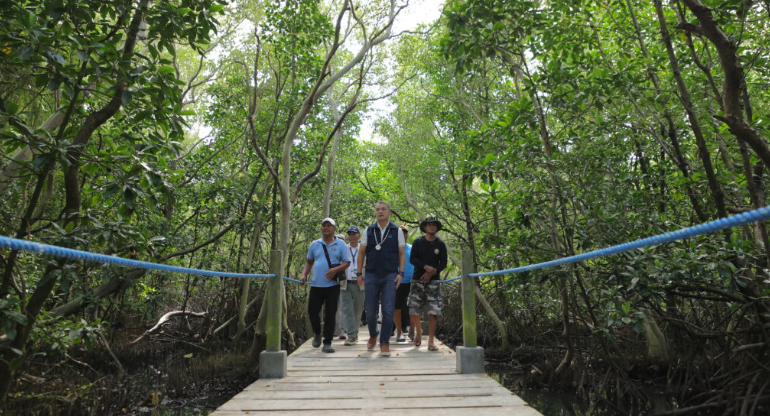
Environment Secretary Juan Miguel “Mitch” T. Cuna, together with DENR regional officials, Balanga City Mayor Raquel Garcia, and community representatives, recently inspected the Balanga Wetland and Nature Park to assess ongoing conservation and restoration efforts.
The Department of Environment and Natural Resources (DENR) has provided technical assistance, capacity-building programs, regular monitoring, and River Rangers to help maintain waterways and protect coastal resources. It has also installed trash traps and waste interception systems to prevent pollution from reaching mangrove and estuarine areas.
Community participation has played a major role in the project’s success, with local fishermen and volunteers helping plant and maintain mangroves along the coastline.
Fisherman Benjie Manuel said the restored mangroves have helped protect nearby homes and fishponds from stronger waves during recent typhoons. He also noted improvements in fishery yields, with fishermen’s incomes reportedly more than doubling.
Meanwhile, local seafood processor Armanda Battad said the restored ecosystem has helped ensure a more stable supply of seafood while attracting visitors and creating additional opportunities for tourism and local businesses.
Despite these improvements, the DENR and community volunteers continue to address pollution through regular cleanups, maintenance of trash traps, and monitoring of rivers and mangrove areas.
The experience of Balanga City highlights how mangrove conservation and community-led environmental initiatives can help reduce climate risks while protecting livelihoods and supporting sustainable local development.