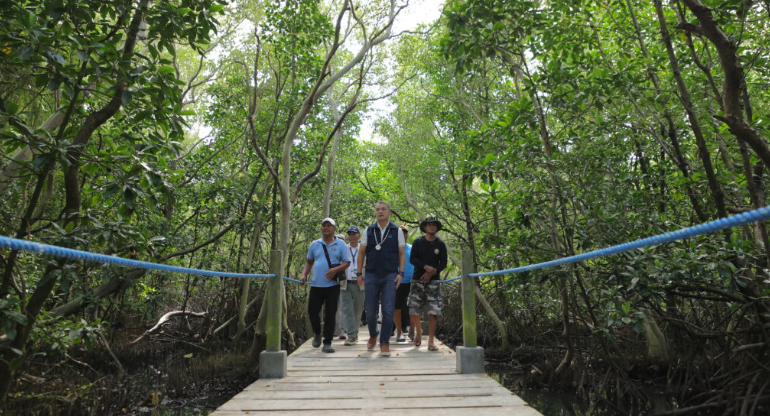

(Photo courtesy of PNA)
LUNA, Apayao – The provincial government of Apayao expects limited agricultural damage from El Niño as regular afternoon rainfall begins to ease dry conditions across the province.
Governor Elias Bulut Jr. said Thursday that the province’s distinct rainy season has helped reduce the potential impact of the developing dry spell on local agriculture and water resources.
“Nag-start na ang rainy season. So, hopefully, that can contribute sa pagbawas ng effect ng El Niño. May damage talaga sa atin kasi nagiging dry ang lupa pero nag-start na, two weeks nang umuulan every afternoon (The rainy season has begun, which we hope will contribute to reducing the effects of El Niño. There will be damage because the soil dries up, but it has been raining for two weeks already),” Bulut said.
He expressed optimism that continued rainfall would help replenish natural springs and raise river water levels, providing additional water supplies for farming communities.
Unlike many other parts of the country, Apayao typically experiences its rainy season from October to February, with rainfall sometimes extending until March.
The Philippine Atmospheric, Geophysical and Astronomical Services Administration (PAGASA) earlier warned that the country could experience a strong El Niño during the final quarter of 2026, potentially intensifying into a very strong episode in the first quarter of 2027.
Despite the forecast, Bulut said most rice and corn farmers in the province have already completed their harvests, reducing the immediate risk of crop losses.
“We are almost done,” he said.
The governor added that farmers in irrigated areas are monitoring rainfall conditions before deciding whether to proceed with a second cropping season.
He said sufficient rainfall would allow irrigation systems to support another planting cycle, particularly for rice production.
Meanwhile, Luna Mayor Januario Garde said the municipal government is undertaking improvements to its potable water supply and irrigation systems to strengthen water availability for residents and farmers.
The infrastructure improvements are expected to take approximately three years to complete.
“Rice and corn production are the primary source of livelihood of our people,” Garde said.
Local officials said maintaining reliable water supplies remains important to protecting agricultural production and sustaining livelihoods as the province prepares for the possible effects of a prolonged El Niño.