President Ferdinand R. Marcos Jr. joined Asia-Pacific leaders in concluding the 2025 APEC Economic Leaders’ Meeting on Saturday, as member economies adopted the Gyeongju Declaration — a landmark pact to harness artificial intelligence (AI), digital innovation, and inclusive growth across the region.
The declaration, issued after two days of talks chaired by South Korean President Lee Jae Myung, reaffirmed APEC’s commitment to strengthen cooperation and pursue economic growth “that benefits all,” noting that rapid AI development and demographic shifts are transforming labor markets and regional strategies.
“APEC economies stand at a pivotal juncture,” the document stated.
The leaders agreed on three priorities: building the world’s most dynamic and interconnected regional economy, preparing for digital and AI transformation, and ensuring shared and inclusive growth.
They also endorsed the APEC AI Initiative, which aims to advance AI capacity-building across sectors, and the APEC Collaborative Framework for Demographic Changes to help members adapt to aging populations and evolving workforces.
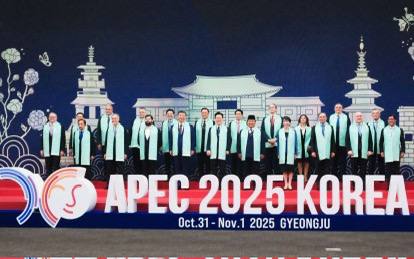
Marcos joined his counterparts for the traditional APEC group photo, where all leaders wore mint-green scarves made of traditional hanbok fabric.
At the closing ceremony, Lee officially handed over the APEC chairship to Chinese President Xi Jinping, who will host the 2026 summit.
This year’s meeting, themed “Building a Sustainable Tomorrow: Connect, Innovate, Prosper,” marked the first time APEC leaders achieved consensus on a joint response to digital and demographic challenges.
Future hosts were also confirmed: Vietnam (2027), Mexico (2028), Singapore (2030), Japan (2031), Chile (2032), Papua New Guinea (2033), and Peru (2034). The 2029 host will be announced later.