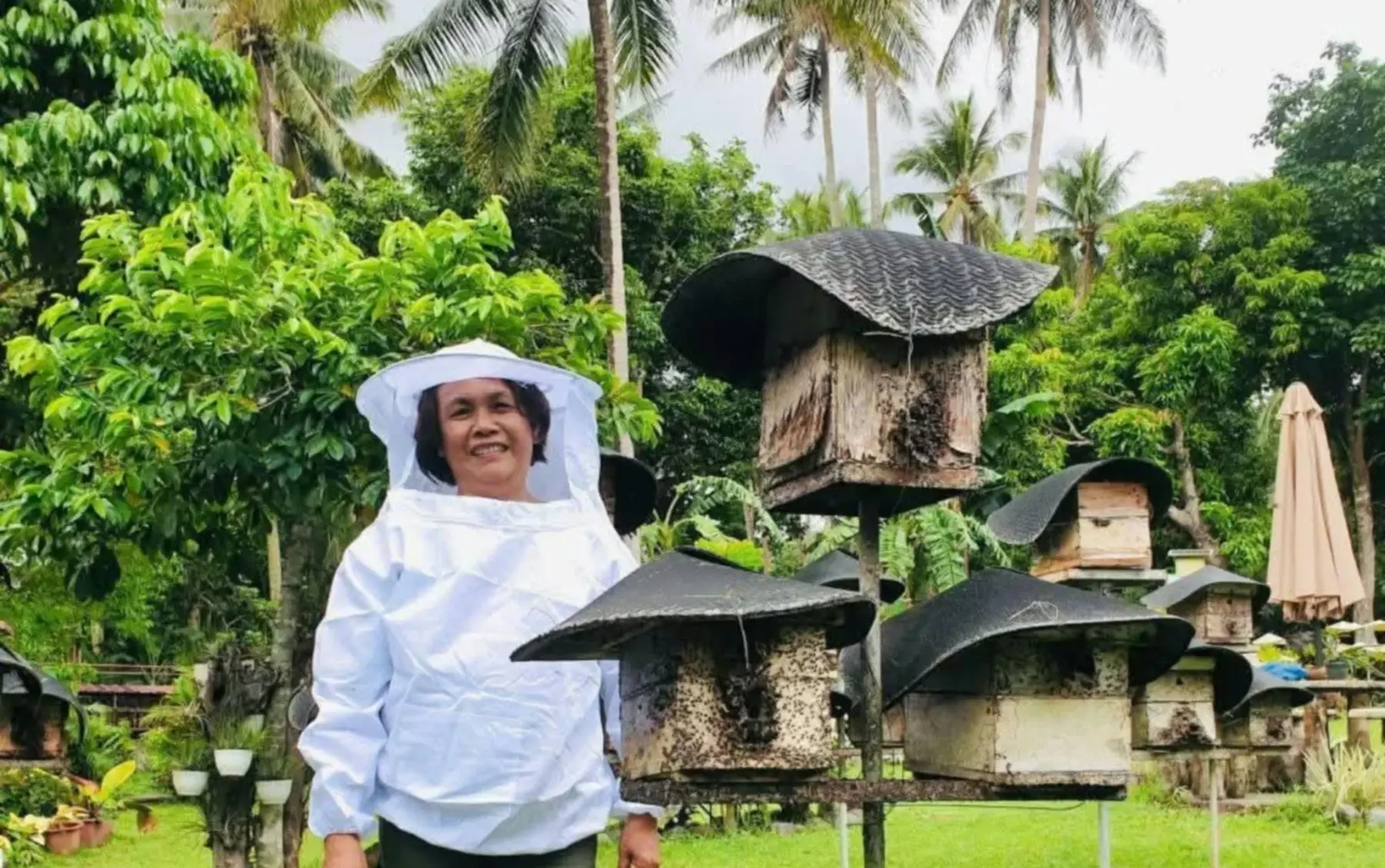

(Photo courtesy of Jocelyn Caratao)
DARAGA, Albay – What began as a widow’s determination to provide for her five daughters has grown into a thriving beekeeping enterprise, transforming a 2.3-hectare farm in Albay into a source of livelihood, education and inspiration for aspiring farmers.
At 61, retired elementary school teacher Jocelyn Caratao continues to manage Nelly’s Garden and Bee Farm, an agricultural enterprise that started with just four stingless bee colonies and has expanded to 875 colonies across two sites.
Her journey into beekeeping was rooted in a lifetime of agricultural experience, family responsibilities and a desire to make farming more sustainable.
From farming roots to family struggles
Caratao grew up in a farming household where her parents earned a living through copra production, rice cultivation and livestock raising.
As the eldest of four siblings, she learned early to perform physically demanding farm work, including gathering coconuts, preparing copra and tending to carabaos and cattle.
“The four of us siblings were raised through our parents’ livelihood in copra production, rice farming, and livestock raising. I experienced helping them in every stage, from gathering fallen coconuts and hauling them home to splitting the nuts, drying the copra, and packing it into sacks,” she recalled.
Even after becoming a teacher and raising her own family, agriculture remained an important source of additional income.
Her responsibilities grew heavier in 2006 when her husband died, leaving her to raise five daughters, then aged 20, 15, 11, 7 and 5.
“It was not easy when I became a widow. I had five daughters, aged 20, 15, 11, 7, and 5 at the time, and all of them were studying in private schools. I knew I had to be strong because I was the only one they could depend on,” she said.
Despite the financial and emotional challenges, Caratao continued working and farming to support her children’s education.
Four bee colonies become 875
A turning point came in 2017 when Caratao received the title to her agricultural property under the government’s Comprehensive Agrarian Reform Program (CARP).
That same year, a family trip to Baguio City introduced her to a bee farm operated by women.
Inspired by what she saw, she decided to explore stingless beekeeping as a way to improve pollination and increase productivity on her land.
“We got the idea when we visited a bee farm managed by women. Seeing them run the operation inspired us to venture into beekeeping ourselves,” she said.
“Deep in my heart, I believe this was the answer to my prayer of pursuing agriculture that is not overly difficult to manage but offers so much more.”
Caratao initially invested Php 6,000 to purchase four stingless bee colonies.
Nine years later, her operation has expanded to 875 colonies, consisting mainly of Tetragonula biroi, locally known as “kiwot,” alongside a smaller population of Laeviceps or “mongo-mongo” bees.
What began as an effort to improve pollination of coconut and fruit trees eventually developed into a business producing honey and other bee-related products.
The farm now offers raw honey, bee bread, pollen, propolis, beeswax and nucleus colonies for beekeeping operations.
Turning a farm into a learning center
Beyond producing honey, Caratao has transformed Nelly’s Garden and Bee Farm into an agricultural learning destination.
In 2020, the Department of Agriculture’s Agricultural Training Institute accredited the property as a learning site for agriculture.
The farm provides hands-on training in hive installation, colony splitting, honey harvesting and other essential beekeeping practices.
For Caratao, the opportunity to teach others has become another meaningful chapter in her life.
“As a beekeeper, I will never stop teaching others about stingless beekeeping. I want to help more people, particularly coconut farmers, recognize its potential, given how well stingless bees thrive in coconut-growing areas,” she said.
Her efforts to promote agricultural education and sustainable farming earned recognition in 2025 when she received the Excellence Award during the ONRA Annual Animal Extension Workers Achievers’ Awards, sponsored by the Albay provincial government.
A mother’s lasting achievement
Today, Caratao’s five daughters have completed their education and established their respective careers.
Her eldest works in the private sector, two serve as officers in the Philippine Navy, another practices veterinary medicine, and her youngest has earned a degree in architecture.
Although she could now enjoy retirement, Caratao remains committed to expanding her agricultural enterprise and sharing her knowledge with other farmers.
She credits the land awarded through CARP as a major factor in helping her build a livelihood and secure her family’s future.
“To me, owning land through CARP means life. CARP is not just about land; it is about hope. It gave me the opportunity to plant crops, raise pigs, and eventually venture into stingless bee farming. Most importantly, the land helped me send my children to school and finish their studies. Today, they all have their own professions,” Caratao said.
For the former teacher, the farm represents more than a successful agricultural business. It stands as a reminder of how determination, land ownership and sustainable farming can create opportunities for families and communities.
From four colonies to hundreds of thriving hives, Caratao’s journey demonstrates how a small agricultural investment can grow into a lasting source of livelihood and knowledge.