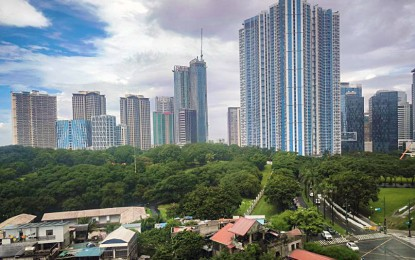

The skyline and business district of Bonifacio Global City in Taguig City are photographed on Oct. 4, 2024. The World Bank on Thursday (June 19, 2025) said boosting private sector growth and continued structural reforms will help boost economic growth. (PNA photo by Joan Bondoc)
The World Bank emphasized that accelerating structural reforms and fostering private sector development—especially among small and medium enterprises (SMEs)—will be key to boosting the Philippine economy’s long-term growth prospects.
In its latest Philippine Economic Update (PEU) released Thursday, the multilateral lender projected the country’s gross domestic product (GDP) to grow by 5.3 percent in 2025. Growth is expected to pick up slightly to 5.4 percent in 2026 and 5.5 percent in 2027.
The report pointed to a strong labor market, low and stable inflation, and supportive fiscal and monetary policies as drivers of this outlook. These factors, it said, would help counter the negative effects of rising global trade barriers.
However, the World Bank stressed that unlocking the full potential of high-growth SMEs will be essential to enhancing the country’s economic resilience and dynamism. It recommended improving access to testing facilities and certification services, simplifying regulatory requirements for laboratories and imported testing equipment, and ensuring international recognition of Philippine standards.
In a briefing held in Makati City, Jaffar Al-Rikabi, the World Bank’s Senior Country Economist for Economic Policy, said implementing structural reforms remains crucial for long-term growth.
“The government needs to invest in foundational infrastructure to support job creation, particularly in areas like connectivity and addressing skills gaps,” he said. “Improving governance and streamlining business regulations are also essential to creating a more favorable business environment.”
Al-Rikabi also highlighted the importance of attracting more private capital to support public spending. Over the medium term, he said, reforms to improve domestic revenue collection and make public spending more efficient would help the government implement its fiscal strategy and rebuild buffers against future shocks.
Among the risks cited to the country’s economic outlook were heightened policy uncertainties, a slowdown in global growth, and regional conflicts that could push up commodity prices and disrupt global logistics.
On a positive note, the World Bank forecasts Philippine headline inflation to average 2.4 percent this year—well within the government’s official 2 to 4 percent target range.