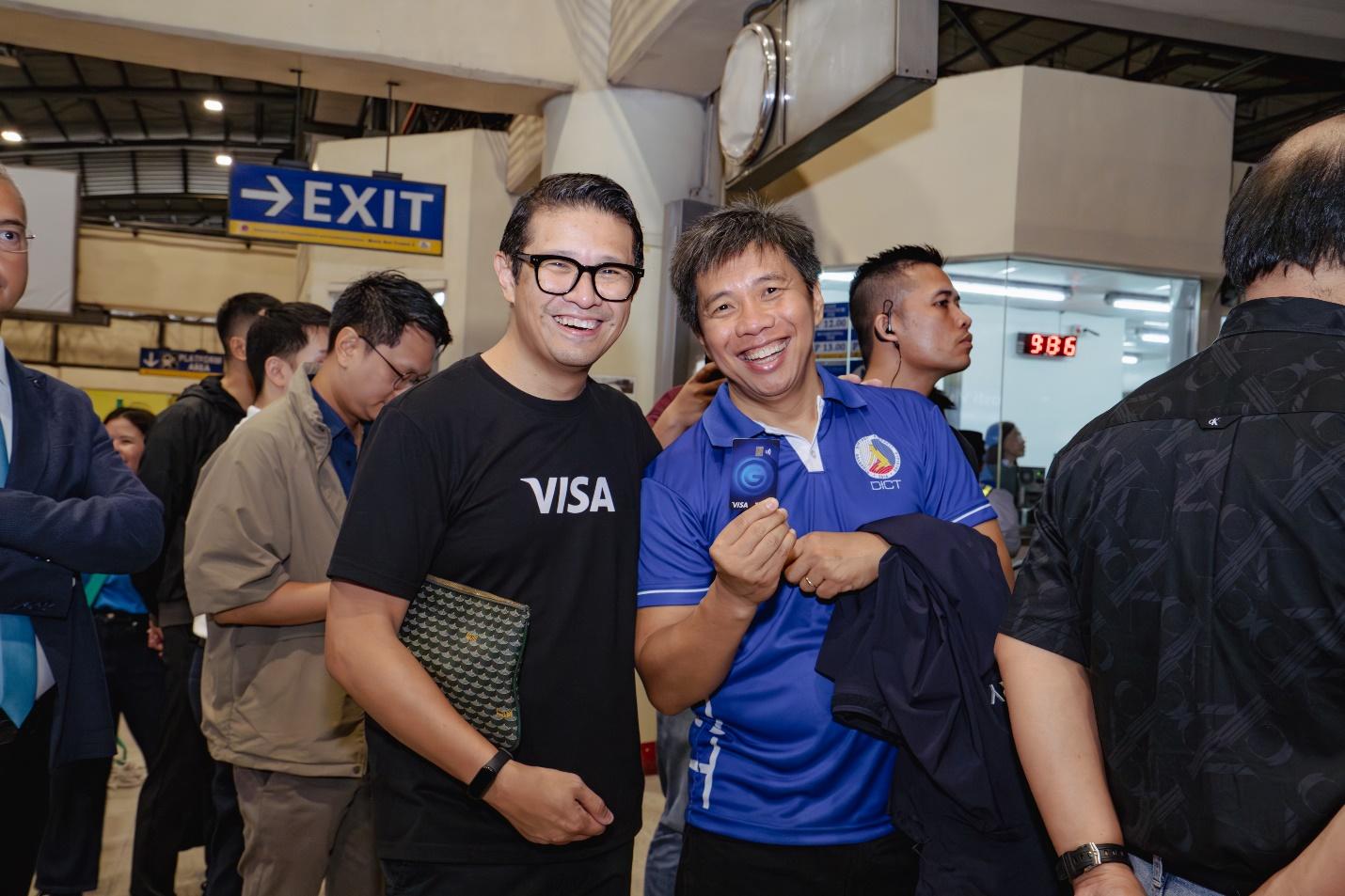

Visa Philippines Country Manager Jeffrey Navarro, together with Department of Information and Communication Technology (DICT) Secretary Henry Aguda, demonstrated the new tap-to-ride payment feature at the MRT-3 using a Visa card.
Metro Manila’s daily commute just got a high-tech upgrade.
Visa, a global leader in digital payments, has teamed up with the Department of Transportation (DOTr) to roll out automated, contactless fare collection across all 13 stations of the Metro Rail Transit Line 3 (MRT-3). The move aims to transform the daily experience of over 350,000 passengers—offering faster, safer, and more convenient rides while unlocking broader economic and tourism benefits for the country.
A new era of urban mobility
Thanks to Visa’s latest infrastructure project—their third major transit initiative in the Philippines—commuters can now tap their Visa card, scan a QR code, or use an NFC-enabled device to ride the MRT-3. That means shorter lines, quicker boarding, and fewer delays.
According to the Visa Economic Empowerment Institute, contactless, open-loop systems like this can increase public transport ridership by up to 10%. That translates to smoother city living and stronger local economies.
“Efficient transport is the backbone of a thriving city,” said Jeffrey Navarro, Visa’s Country Manager for the Philippines. “Upgrading fare systems not only improves the commuter journey—it boosts productivity, attracts investors, and connects people to opportunity.”
Raising the bar for Metro Manila
The MRT-3 upgrade puts the Philippine capital in the same league as Tokyo, Singapore, and Bangkok when it comes to modern, user-friendly transport systems. Visa’s Global Urban Mobility Survey revealed that 58% of commuters in the Asia Pacific region want a unified way to pay for all modes of transportation, while 96% expect contactless options.
Metro Manila is now checking both boxes.
Financial inclusion on the move
Beyond convenience, this project is helping bridge the financial divide. By leveraging devices and cards already in widespread use, Visa’s system allows even unbanked or underbanked commuters to begin accessing digital financial tools—making mobility a gateway to financial inclusion.
“Public transport can be a powerful tool for inclusion,” Navarro said. “When we make it easier for people to commute, we also make it easier for them to engage with the digital economy.”
A boost for tourism
The benefits aren’t just for locals. International travelers, who often carry cards but struggle with cash-only systems, will find it easier to explore Metro Manila using familiar payment methods. Visa’s 2023 Global Travel Intentions Study shows 97% of Asia Pacific tourists bring cards—but nearly half run into payment roadblocks in the Philippines.
“Tourists expect seamless experiences,” Navarro added. “When we modernize transport payments, we’re also encouraging them to stay longer, spend more, and promote the Philippines as a forward-looking destination.”
Rolling out nationwide
The MRT-3 upgrade follows Visa’s successful launches in Cebu, Mandaue, and Bacolod, where more than 1.4 million residents and tourists now enjoy tap-to-pay jeepney rides. These regional successes are part of Visa’s global network of over 870 contactless transit projects—each one focused on smarter cities and more inclusive communities.
As contactless mobility continues to spread across the Philippines, Visa is helping pave the way for a future that’s faster, more inclusive, and built for growth.