
For decades, payroll account opening has been one of the quiet bottlenecks of Philippine business operations. What should be a routine HR function often turns into a drawn-out exercise in paperwork, manual checks, and coordination across multiple teams—slowing employee onboarding and diverting time from more strategic work. UnionBank is now decisively changing that narrative and setting a new benchmark for digital payroll in the country.
With the launch of Zero-Touch Onboarding, UnionBank introduces the Philippines’ first end-to-end payroll account opening solution that removes manual intervention entirely from the employer’s side.
Built on its Business Banking platform, The Portal, the solution compresses what traditionally takes up to two weeks into a process that can be completed in under 24 hours, enabling salaries to be credited as early as the next banking day after employees finish onboarding.
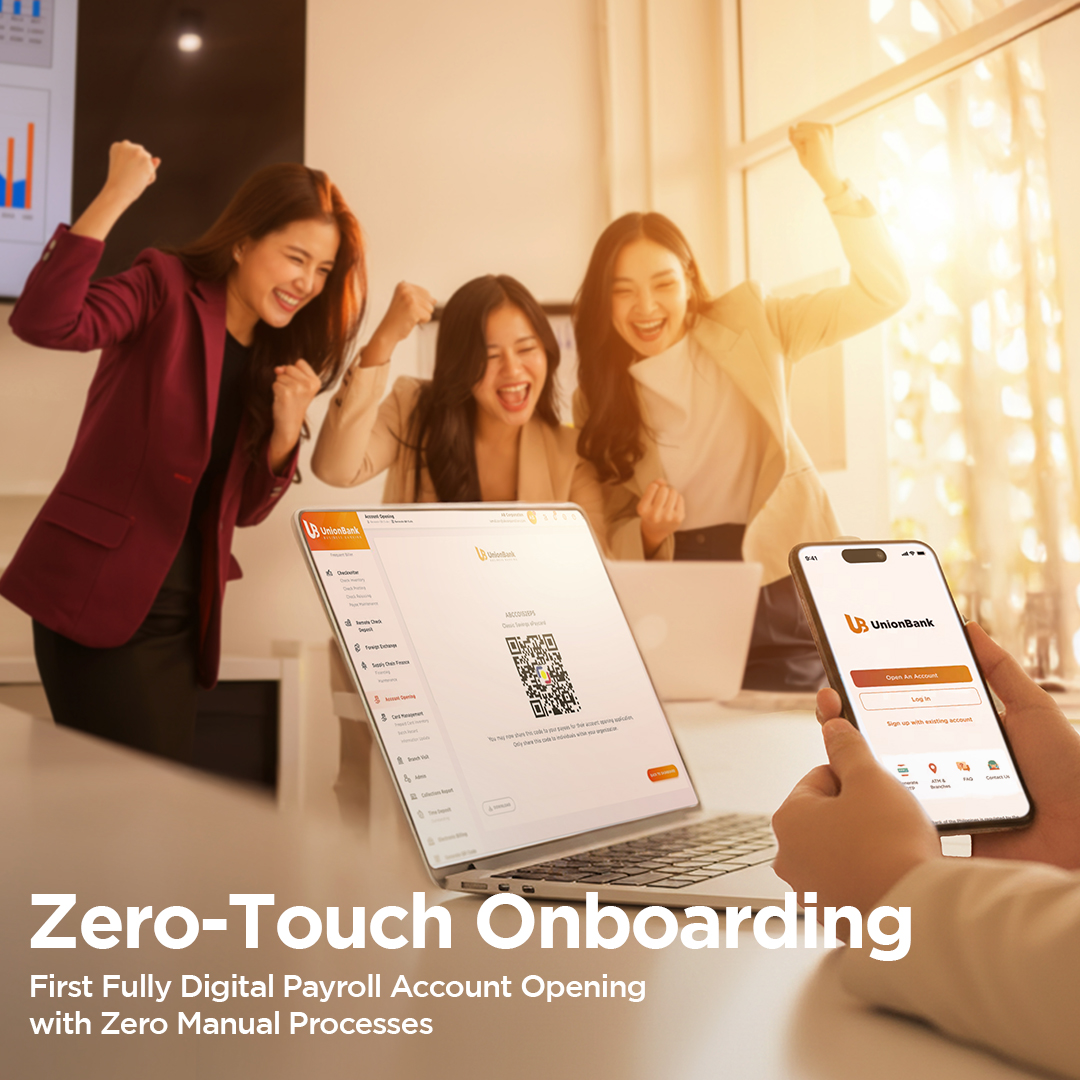
Rather than simply digitizing an old workflow, UnionBank has reengineered payroll onboarding from the ground up. Employers no longer need to collect documents, review submissions, or coordinate approvals. Employees initiate the process on their own devices by scanning a QR code generated through The Portal, then complete account opening within minutes using the UnionBank Online app.
Verification, approval, and activation are handled seamlessly by the bank, while HR teams gain instant visibility of newly opened accounts directly on the platform.
According to Erika Denise Dizon-Go, Senior Vice President and Deputy Head of UnionBank’s Transaction Banking Center, the goal was to remove friction at its source. Zero-Touch Onboarding, she said, gives companies back valuable time while making banking simpler and more intuitive for employees—placing efficiency, speed, and customer focus at the center of the payroll experience.
The new solution builds on UnionBank’s track record of digital firsts. In 2021, the bank introduced eDAO or ePaycard Digital Account Opening, the country’s first digital onboarding alternative for corporate payroll accounts. Zero-Touch Onboarding goes further by eliminating HR handling altogether, delivering a true hands-off experience for organizations without sacrificing compliance or security.
Beyond convenience, the shift signals a broader change in how payroll banking is defined. By embedding automation directly into business workflows, UnionBank positions payroll not as an administrative afterthought, but as a strategic enabler of faster hiring, smoother employee experiences, and more agile operations.
This approach reflects how leading digital banks globally are evolving—using technology to simplify complexity rather than adding layers to it.
UnionBank’s leadership in this space is underscored by its consistent recognition as Digital Bank of the Year by The Asset’s Triple A Awards and as Best Digital Bank Philippines by Asiamoney and International Finance Magazine. Zero-Touch Onboarding strengthens that reputation, reinforcing the bank’s role as a standard-setter in NextGen corporate banking.
As Philippine businesses accelerate digital transformation, UnionBank’s latest innovation offers a clear signal of where payroll banking is headed: fully digital, frictionless, and designed around real operational needs. In doing so, the bank is not just modernizing a process—it is redefining what businesses should expect from payroll banking in a digital economy.
Companies interested in UnionBank’s Zero-Touch Onboarding may contact business@unionbankph.com or visit www.unionbankph.com for more information. Deposits are insured by PDIC up to ₱1,000,000 per depositor. UnionBank of the Philippines is regulated by the Bangko Sentral ng Pilipinas.